Into the air

This story was subject to reporting errors at the time, and speculation continues to this day. Where sources are in conflict, I've chosen the ones I've judged the most reliable. Be aware that some of the details are gruesome.
Fifty years ago, almost to the day, an extraordinarily strange thing happened.
I wasn’t yet born, although my parents had recently shared the news I was on my way, the first grandchild to each side of the family. My mum’s side was from Southland, where she and dad would meet and settle. My dad and his family were from Scotland. Dad had emigrated to Aotearoa in the early 1970s, leaving his father, mother and brother behind him.
The world seemed bigger back then, and throughout my childhood, communications with the Scottish side of the family were through occasional phone calls, or the blue aerogramme letters – lightweight, to keep the cost of postage down – that arrived in grandma’s fastidious handwriting. Mostly, I got to know my grandparents through a handful of photographs and stories.
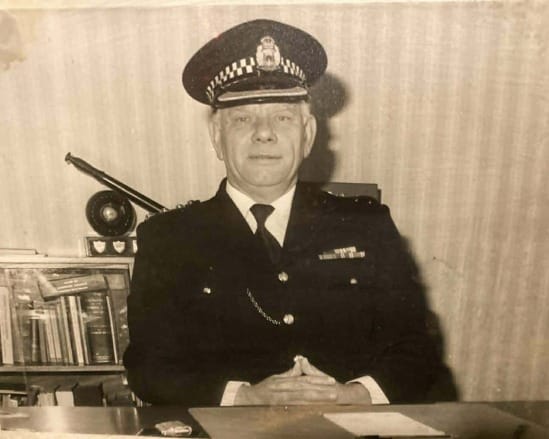
I learned that my Scottish grandad, Malcolm McMartin, had built his career as a police officer on the west coast of Scotland. This was not a job for the fainthearted: many of the stories of his work were too bleak to share with a child. But other stories were evocative or even funny. Grandad’s ability had seen him rise high in the ranks, but he’d started out on the frontline, relocated from place to place as the job required, even living in police houses without electricity. He would cycle his rural beat along rough tracks, my grandmother sometimes taking calls for his help, and estimating for callers where along his rugged journey he might be, so they could guess where and when to flag him down.
And his beat extended to the islands off the coast, generally accessible only by ferry. According to a story I believe was told at his funeral, he’d once got a call from a publican on one of the islands, reporting blokes were smashing up his pub in a fight. My grandad responded with his trademark humour, “I can be there in about an hour and a half. Try to keep it going”.
By the end of his career, grandad was Chief Inspector Malcolm McMartin. He commanded the west coast area of Scotland: the mainland and the sparsely populated islands, towns and villages, mountains and hills, coast and sea. The terrain and its people offered every kind of policing challenge.
Part of grandad’s responsibility was the Isle of Mull.
Fifty years haven’t dulled the public fascination for the story I’m going to try to tell you. It’s been taken up over and again by journalists, hobbyists and conspiracy theorists, but I think it belongs also to my grandad and those who served alongside him: the ones who took torches and trudged through a storm in the dark, who searched the hills and the lochs and the ocean, for an answer they never found.
Norman Peter Gibbs, known as Peter, was talented, impulsive, and ultimately self-defeating – lucky until the moment he wasn’t.
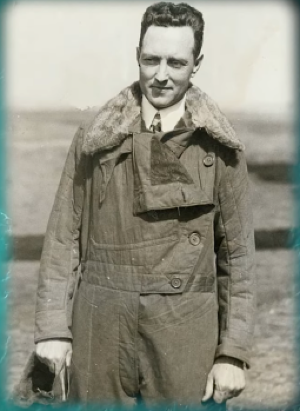
Gibbs was born in 1920 in Swindon, Wiltshire, to parents named Reginald and Florence. Given what we know about his later life, it’s surprising there’s so little on record about his early years – but he entered history with a flourish in the mid-1940s, cutting a goodlooking figure in his serviceman’s uniform. He joined the RAF and flew a Spitfire towards the end of the war, shooting down four German V1 flying bombs, or doodlebugs.
The war was the beginning of Gibbs’ lifelong love affairs with flight and risk. His son, Michael, would later say of him, “In flying he took things to the limit. He enjoyed doing exciting things: he liked – not dicing with death but dicing on the edge of life.”
After the war Gibbs pivoted to a different career altogether, becoming a professional violinist in 1954. He played with various groups, one of which was the Philharmonia Orchestra. His time with the orchestra was marked by a couple of incidents that earned him a reputation. In the first, he let a bag of live grasshoppers loose during a performance. But it was the second incident that brought Gibbs’ tenure with the orchestra to an abrupt end.
During a 1956 tour of the US, the orchestra played in Boston, where conductor Herbert von Karajan – himself notorious for his behaviour – walked offstage the moment the music was finished, refusing to stay for applause or return for an encore. At a rehearsal the next morning, Gibbs gave the conductor a piece of his mind. He said to von Karajan in front of the assembled musicians, "I did not spend four years of my life fighting bastards like you to be insulted before our own allies as you did last evening." Von Karajan only appeared to let the insult go – and at the concert that night, he refused to take the stage until he got agreement Gibbs would be sacked.
Gibbs joined the Surrey Flying Club after parting ways with the orchestra, and flew regularly for the next 18 years. He bought himself a Tiger Moth, and on one occasion used it to drop flour bombs on a bus. In 1959, he destroyed the Tiger Moth in a forced landing caused by an engine failure, although he was unhurt. Gibbs’ son later recounted a more serious ‘prang’ from which Gibbs did not come off unscathed, emerging with petrol in his injuries and spending three months in hospital, where “they had to glue together his kneecaps”. He had somehow escaped the worst, but he didn’t heed the warning. As Gibbs’ son put it, “He shouldn’t really have carried on flying, but he did”.
In about 1972, now aged in his fifties, Gibbs changed career again, to developing and acquiring property – but his new livelihood didn’t mean his risk-taking days were behind him. It was property that three years later brought Gibbs and his impetuousness to Mull.
To get to Mull, visitors generally set out from the mainland town of Oban, traveling over a stretch of sea, the Sound of Mull. At their closest point, Mull and the mainland are near neighbours as the crow flies – but for those who journey by ferry, which is most, the trip follows a longer route around the isle, for almost 26 kilometres. People visit Mull for its landscape: its coastline of some 480 kilometres, with cliffs and inlets and white sand beaches, its mountainous interior, its moorlands and forests and lochs. They visit for the isle’s history too, standing stones and cairns, brochs, castles and duns. Visitors tend to arrive in summer, swelling Mull’s ordinary population of about 3,000.
The ferry from Oban disembarks at Craignure, and from there, visitors can drive 18 kilometres west to the small village of Salen.
Just out of Salen village, overlooking the Sound of Mull, is the Glen Forsa hotel. It was owned for years by the Howitt family, who rebuilt it after it burned to the ground in 1968. Decades later, reflecting on the story I’m about to tell you, David, one of the Howitt sons, would recount tales of the place, including one in which his mother, clearly a superstitious woman, had room 14 of the hotel exorcised because “all sorts of nasty things” had happened in there.
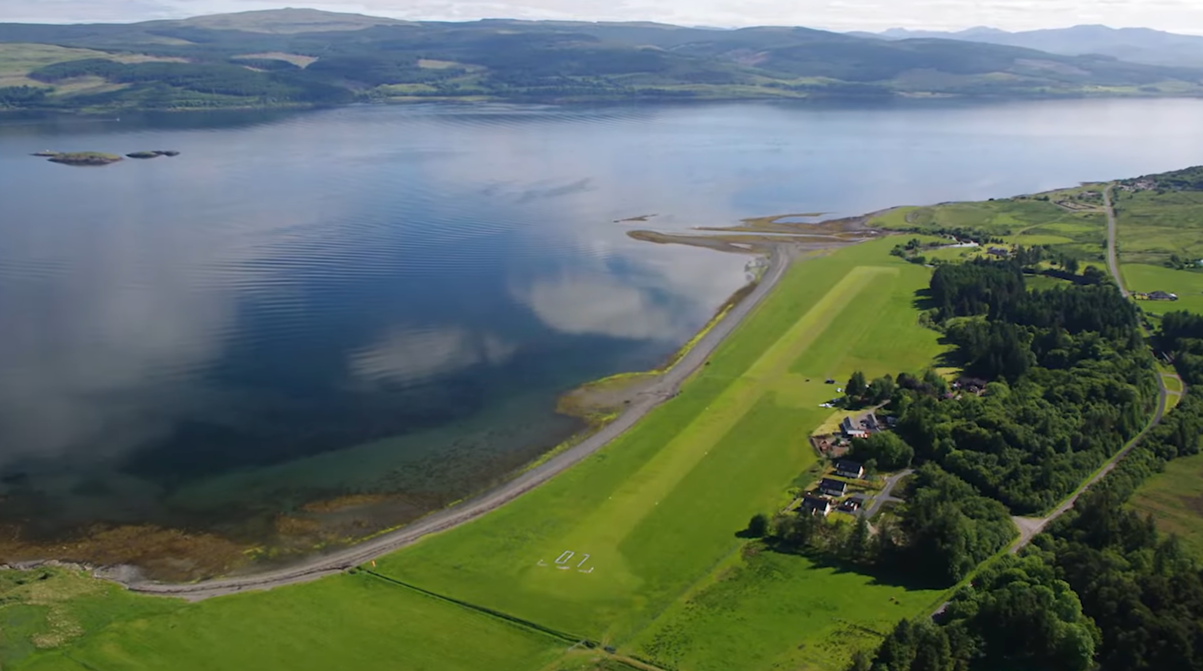
Between the hotel and the shoreline runs an airstrip, formerly operated by the Howitts – but one that to this day is without a control tower, radar, or even runway lights. A simple strip of grass, it was built in 1966 by the Royal Engineers to carry out medical evacuations: the only place on Mull where fixed-wing landings were possible. The airstrip was and is Visual Flight Rules only, a designation meaning pilots can only fly when conditions are suitable to navigate by sight; that is, in daylight and good weather.
About one kilometre east of the hotel and airstrip, heading back in the direction of Craignure, is Pennygown churchyard, with a chapel dating from the twelfth or thirteenth century and a surrounding cemetery. Howitt, perhaps sharing his mother’s superstition, has called the churchyard “haunted rotten”. He explained how the villagers had tried again and again to put a roof on the chapel, only for the faeries to take it away.
Behind the cemetery is a hill. Although small, the hill is boggy and slippery with sheer rock faces; a difficult climbing terrain, even in good conditions.
It is these four places – the Glen Forsa hotel, the airstrip, the cemetery and the hill behind it – that set the scene for our story.
On 20 December 1975, Gibbs arrived on Mull, a place he knew well, aboard the ferry from Oban. He was with his girlfriend, a 32-year-old university lecturer named Felicity Grainger. Gibbs was looking for a luxury hotel to add to his property portfolio, and the Glen Forsa hotel, with an airstrip directly outside, seemed an attractive possibility.
Gibbs and Grainger checked into the hotel, room 14.
Soon after, Gibbs found out that back on the mainland, just out of Oban, there was a Cessna for hire. The temptation was too great for an adventurer to resist. Gibbs arranged to meet with the Cessna’s owner and collect the plane. When the owner asked to see Gibbs’ pilot’s licence, Gibbs told him he hadn’t brought it, because he didn’t anticipate he’d be flying during his visit to Mull. This would turn out to be untruthful. Gibbs’ licence had lapsed because he hadn’t sat the compulsory test to renew it. More than that, even when current, his licence had required him to wear glasses while flying – something he’d never done – and did not allow him to fly at night.
It was the afternoon of Christmas Eve when Gibbs flew the Cessna from the mainland back to Mull, parking it by the airstrip, and headed into the hotel. He and Felicity each enjoyed a whisky, followed by a meal with a glass of red wine. Since their arrival on Mull, Gibbs had been musing: what if it were possible to use the airstrip at night? The navigational beacons in the nearby Sound of Mull, as well as the hotel, might just provide enough light. If they did, planes would be able to come and go when they pleased, making the Glen Forsa more appealing to wealthy clientele, and an even better investment.
As dinner ended, Gibbs hatched the plan that would set in train the events to follow.
Gibbs announced he would take the Cessna for a spin, a short circuit around the airstrip. A circuit is a commonly-used flight pattern that makes a loop around an airfield. If there were ever a night for such a reckless experiment, this wasn’t it: there was no moon above the sparsely populated, barely lit isle, and although the sky was clear at that moment, a storm was forecast to arrive soon. Roger Howitt, the hotel manager and brother of David, warned Gibbs against the flight, only for Gibbs to respond that he was not asking permission, but only letting staff know as a courtesy. Gibbs changed into his flying gear, and at about 9:15pm, he and Felicity made their way out to the plane.
Felicity was charged with lighting the airstrip for take-off and landing by holding two torches Gibbs had borrowed from the hotel. Improvisation was in keeping for Gibbs – his son later said he’d once used candles in jars as runway lights. What happened next is disputed, and the dispute would later fuel conspiracy theories. Some witnesses believed the two torches appeared too far apart in the darkness to be held by a single person, and they claimed they heard the Cessna run an unusually long time to warm up. Whatever the truth, at about 9:30pm, Gibbs opened the Cessna’s throttle and accelerated down the airstrip.
Felicity stood at her post with the torches. She was joined by David Howitt, who’d heard the Cessna’s engine, wondered to himself, “What on earth is that madman doing?”, and rushed out with his binoculars. The pair of them looked upwards as the Cessna climbed to about 150 metres. With night flights such a rarity, the hotel’s patrons rushed upstairs to watch, flocked to the windows, and turned off the hotel’s lights for a better view. The plane moved beyond a stand of trees and out of sight. It should have taken only seconds to turn back towards the airstrip, reappear above the trees, then complete its circuit.
There was nothing.
Puzzled, David Howitt went inside and checked his radio set. There was no distress call. By now, the forecast storm had set in. Howitt climbed into the hotel’s blue Cortina and drove through sleet and snow to the cemetery, where he could pull up close to the sea. He figured that if Gibbs had undershot the runway and been forced to ditch the plane, this is where he might have landed. Howitt used the Cortina’s headlights to sweep the water but spied nothing through the darkness and the weather.
At 10:00pm, Felicity gave up waiting on the airstrip – and distressed and chilled to the bone, she went back into the hotel. The people around her tried to comfort her: Gibbs had probably changed his mind owing to the weather and headed for the mainland, maybe Glasgow or Prestwick, somewhere better equipped for night landing. They gave it a little longer, but with no word of Gibbs, David Howitt made a 10:30pm call to Air Traffic Control at Prestwick. The aviation authorities hadn’t heard from Gibbs either.
At 11:20pm – about the time the Cessna, if still airborne, would have been sputtering through the last of its fuel – police were called. Two local cops, from Salen and the nearby town of Tobermory, formed a search party with David Howitt, and as the clock ticked over into Christmas Day, the three went out into the storm.
In Oban, Chief Inspector Malcolm McMartin, my grandad, must have been accustomed to taking calls in the small hours. I don’t know what it was like for him, exactly, but I imagine that he rose and slid his feet into his slippers to make his way to the phone. Perhaps he said something to my grandma, who had no doubt made their Christmas preparations – or perhaps she was asleep, and he didn’t wish to wake her. I imagine he slid his slippers off again and reached for his uniform.
Grandad led the police inquiry.
At dawn on Christmas Day, the Glen Forsa hotel was transformed into headquarters. Police were flown in, but the sheer size of the isle – almost 900 square kilometres – meant they couldn’t conduct the search alone. RAF mountain rescue teams joined, as well as coastguards, and workers from the Forestry Commission and Department of Agriculture. Locals volunteered alongside them.
By now, the storm had worsened to blizzard conditions. Together, the men formed lines, working close enough that they could speak to one another, combing the length and breadth of the isle. When they came to the lochs, they surveyed the water for signs of a crash: debris or oil.
History doesn’t record it, but the women of the isle surely volunteered too. There must have been shift after gruelling shift to provision, searchers setting out in waves and coming back cold and hungry. Perhaps the women abandoned their Christmas preparations, or brought what they had cooked to the hotel, for the returning men who couldn’t feel their faces, feet or hands.
Helicopters were enlisted from the RAF and Naval Air Sea Rescue, some fitted with sonar so they could scan the sea.
The media descended on Mull almost as quickly as the searchers. TV and radio broadcasts across Scotland appealed to the public for information. Theories, some of them questionable, began to proliferate.
It was late on Boxing Day before the storm began to let up. On 29 December, the land part of the search was completed: with the whole isle having been covered by both men and helicopters, there was simply nowhere left to look. Most of the searchers stood down, but throughout January, police continued to scour the shoreline, figuring by deduction that Gibbs and his plane must have crashed into the sea. Nothing was found.
At some stage soon after, grandad must have made the call to scale back again. This was pragmatic, and the right thing to do – as one of the largest peacetime searches Scotland had seen to that point, it must have consumed vast resources. But I have to wonder if it rankled him, a man whose ability had taken him high in his profession. Gibbs and his plane had simply vanished into the air.
In April of 1976, only hours after learning his first grandchild had arrived, Chief Inspector Malcolm McMartin took another call. It was perhaps the most improbable of his career. Four months of fruitless inquiry had passed since the night Gibbs set out in the Cessna. Now Gibbs’ body had been discovered.
Donald MacKinnon, a Salen shepherd, had been walking the hill behind the Pennygown cemetery, just as he’d done many times since Gibbs’ disappearance. The formal search had covered the same ground at least twice. Yet, some 120 metres up the hill, MacKinnon came across a harrowing sight: the splayed body of a man, badly decomposed and ravaged by animals. The position of the body, lying backwards over a larch that had fallen to the ground, suggested Gibbs had fallen while trying to descend.
MacKinnon hastened back to the village to call the police, who in turn summoned David Howitt in the hope he’d recognise the remains. Howitt did: the man was dressed in the slacks, checked jumper, blue jersey and flying boots that Gibbs had worn for his final flight. Later, dental records would also confirm Gibbs’ identity. Further examination would show, bafflingly, that Gibbs was almost uninjured at the time of his death, except for a superficial cut on one leg.
Chief Inspector Malcolm McMartin, my grandad, stated at the time, “The reasonable assumption now is that Mr Gibbs crashed the plane somewhere up the hill, had a miraculous escape from death or injury, walked down the hill, and succumbed to exposure.”
The assumption may have been reasonable, but it was largely wrong. The discovery of Gibbs sparked another search. Again, police scoured the land and dragged the lochs, but again, there was no plane – and without a plane, grandad’s scenario seemed impossible. The Cessna had no parachute, and with or without one, the plane would have been extremely difficult to exit midair above the hill. Had Gibbs somehow managed to jump free from a low height, the fall would have injured him. If he’d jumped from a height sufficient that the plane kept flying – something grandad’s theory required, to explain why the Cessna hadn’t been found nearby – then the fall, and not exposure, would have killed him.
Then had Gibbs been killed elsewhere and his decaying corpse later moved to the hill? This seemed farfetched, but would explain why neither the searchers nor Donald MacKinnon had discovered the body sooner.
Conspiracy theorists elaborated on the possibility, harking back to witness accounts that the torches on the runway the night Gibbs disappeared were too far apart to have been held by Felicity only. This, some believed, pointed to the presence of a third person – one who might have been Gibbs’ accomplice in some nefarious scheme, and might even have killed Gibbs, perhaps in flight. Some linked this foul play theory to other theories, suggesting Gibbs might have been involved in a diamond theft that took place in Oban days before his flight, or speculating that he was an MI5 operative, and his flight was some clandestine mission against the IRA.
However, Felicity maintained she was the only one on the runway; and in any case, Gibbs’ remains showed no signs of having been moved. The state of his body was consistent with it having been out in the weather, not hidden elsewhere.
In June 1976, two months after Gibbs’ body was discovered, a Fatal Accident Inquiry was held into Gibbs’ death. It discounted most of the theories, and reiterated that Gibbs had died of exposure rather than injury, but in the absence of evidence, struggled to explain how he’d become separated from the Cessna. The Procurator Fiscal involved in the inquiry concluded, "This Inquiry has taken some mystery out, but it has not taken all of the mystery out of this case and until the plane is found, if it is ever found at all, then the mystery will remain."
In a morbid coda to the discovery of Gibbs, as David Howitt would tell it, one of Gibbs’ ex-girlfriends visited Mull and asked Howitt to take her to the place on the hill where the remains were found. Howitt did; and there, in the heather, the two of them saw Gibbs’ scalp, which had detached from his body at the place he’d fallen. The ex-girlfriend picked up the scalp and put it in a plastic bag.
It was a forlorn end to the tale of an adventurer.
Every possibility had proven a dead end.
It would be incorrect to say the mystery of Gibbs’ death was forgotten, but at least for a while, life moved on – for the people of Mull, and for my grandad. After his decades of distinguished service, Malcolm McMartin was nearing retirement. This meant that ten years later, when the story abruptly came to life again, it was another senior police officer who took the call.
In September 1986, a diver named George Foster discovered the wreckage of a plane in the Sound of Mull. It was some 450 metres from the shore and 30 metres beneath the surface – about 2.5 kilometres from the airstrip. At first, Foster didn’t quite grasp what it was he’d found, but he had the foresight to take photos and memorise the details as best he could in the conditions.
Both wings had detached from the plane. So had the engine. A propeller blade was bent back, as if on impact. Both doors were jammed or locked shut, but the windscreen was smashed. One initial theory of Gibbs’ disappearance was that he’d crashed over the sea then somehow made it to shore. The discovery of the underwater plane supported this theory – but it was barely more satisfying than the other theories it replaced.
It now seemed that Gibbs had come to grief over the Sound of Mull, perhaps because the cold had caused the Cessna’s engine to stall. Since he was flying at low altitude, he would have had no time to bail out before hitting the water, yet was somehow unhurt by the impact. The shut doors of the Cessna suggested he may have escaped the sinking plane through the relatively small space left by the smashed windscreen, although how he did this, let alone without injury, is challenging to explain.
Gasping with the shock of water so cold it gave him a maximum survival time of one hour, Gibbs now had to guess the direction to land – in total darkness and a storm. Somehow, he guessed right; and now this man in his mid-fifties, fully clothed and in his heavy flying boots, swam for 20 or 25 minutes, almost half a kilometre, dragging himself onto shore somewhere in the vicinity of Pennygown cemetery.
Now Gibbs found himself standing on the road, and had he continued along it, it would have led him back to the hotel, or someone would have found him. Instead, he began to climb the boggy, slippery, rocky hill behind the cemetery, in the pitch black. Why he did this is as difficult to say as how. It wasn’t that he was affected by alcohol or anything else – his postmortem found no evidence of substances – but after a freezing swim, he would have been cognitively impaired. Despite this impairment, he made it some unknown distance up the hill, again without injuring himself.
It was coming back down the hill that Gibbs slipped, thudding to the ground, or simply lay down with exhaustion, over the trunk of the fallen larch. And it was there, having survived the impossible, under a sky he could not see for the storm, that he finally succumbed, alone. The sleet and the snow made a shroud around him.
George Foster’s underwater photos of the plane were of such poor quality that the details he gave could not be verified. He was unable to relocate the wreckage, and nor could anyone else. It continues to lie at the bottom of the sea.
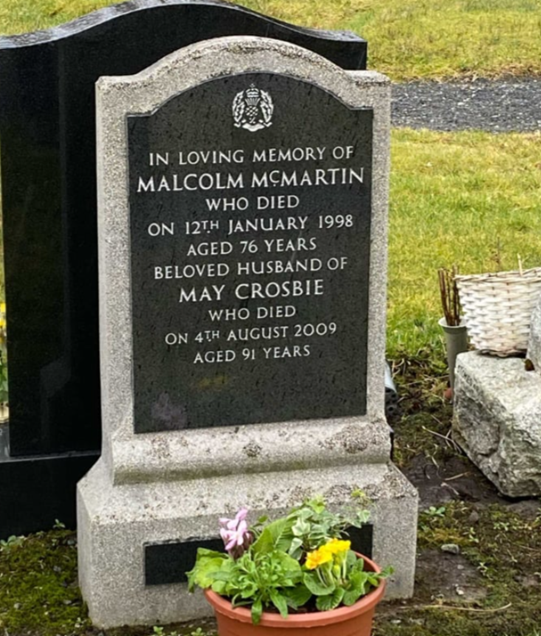
By 2004, my grandad had been dead six years, having passed away at the age of 76, with as much closure as he or anyone else would get.
In February of that year, three naval minesweepers were at work off the coast of Oban: the HMS Pembroke, HMS Penzance and HMS Inverness. Near the Sound of Mull, about 30 metres below the surface, they discovered the wreckage of a plane. It was around the place George Foster had found and photographed the wreckage in 1986, but couldn’t pinpoint after.
Media interest and speculation were instant. A spokesperson for the Royal Navy said, “We think it could be a Cessna, but we have not confirmed that yet.” Confirmation would prove difficult. Poor weather hamstrung the Royal Navy’s attempt to explore the wreckage. So too did its depth: navy divers were trained to descend to 30 metres, but the plane lay at a frustrating 31 metres. When the weather cleared, a remote-operated vehicle was sent underwater to take pictures, but visibility remained poor.
In time, the Royal Navy would solve the mystery – but it was not the mystery they were expecting.
In April 1945, members of the South African Air Force had been training at Oban. In some kind of catastrophe, their Catalina flying boat had crashed into the sea, caught fire and sunk. Miraculously, all nine men on board survived with only minor injury, but the wreckage of the Catalina had never been found.
What George Foster believed was a Cessna was probably the Catalina. If so, then the plane Peter Gibbs flew remains as lost today as it was on Christmas Eve 1975.
I never really got to know my grandad. He and grandma travelled long-haul from Scotland for a couple of visits when I was a kid. I remember a tall and strong man, a mix of no-nonsense and jokes, who’d produce barley sugar lollies stuck with fragments of tobacco from his pockets. The historical record says hardly anything about him, but what little there is, I have excavated in the hope it will one day interest my own kids. My imagination is left to fill in the blanks.
So, too, I fill in the blanks of Peter Gibbs’ final flight.
It must have been only minutes after take-off when he realised it was impossible to navigate in the dark. The light of the torches was never going to be enough. Perhaps the hotel lights could have been, but the patrons had turned those off to better watch his madman’s flight. On another night, lights from the handful of homes on the isle might have helped, or the headlights of cars, or even the lights of ships on the Sound of Mull; but it was Christmas Eve, and there was a storm approaching. People were at home staying safe and warm, getting ready for bed.
The instruments in the Cessna would have given Gibbs his altitude and direction, but could not have told him whether he was over sea or land, and therefore whether he was well above water, or dangerously skimming the top of a hill. It’s impossible to say why no distress call was made: whether the Cessna’s radio wasn’t working, or whether Gibbs simply refused to use it, with the pride of a man whose luck had never yet run out.
Alone in the Cessna, in the darkness, the horror of his misjudgement must have dawned on him. In that moment, he must have realised this reckless act would be his last.
Gibbs’ story is known as The Great Mull Air Mystery, and is retold to this day. That’s the way of things. Reckless men make better stories than the people who must sift through the carnage. Christmas Day in 1975 came and went, and grandad and his colleagues spent it without their families. I don’t imagine grandad begrudged it – this was the job to which he was committed – but I want to acknowledge it all the same.
I wonder what it was like as 24 hours stretched to 48 and then 72, with no sign of a man who, lost in a blizzard, could no longer possibly be alive. I wonder what it was like as, one after the other, every avenue for search was exhausted – as exhausted as the people doing the searching. And I wonder what it was like making the call the search was over, and informing the Gibbs family, who would themselves learn to live with an absence at Christmas.
I wonder, but I missed the chance to ask.
The mystery of Gibbs’ death perplexed grandad until the day that he himself died. Malcolm McMartin lies in Scotland amongst the people he served.
References
The most rigorously researched account I’ve found of The Great Mull Air Mystery is the book Scottish mysteries, by Donald Fraser. I’ve also drawn on the book Scotland’s unsolved mysteries of the twentieth century by Richard Wilson, and a BBC podcast.
Other sources I’ve used include:
· BBC NEWS | UK | Scotland | Mystery plane found on sea bed
· BBC NEWS | Scotland | Navy completes mystery plane probe
· Sunken wreckage identified as crashed wartime flying boat
· The riddle of the lost flight | The Independent | The Independent
Some of the imagery used comes from the following clips: