The grift of the gab

This opinion piece talks about extremist and offensive content. It owes a debt to some excellent reporting by a range of organisations.
Judy is coy about her background.
Last year, when Michael Laws interviewed her for The Platform, she gave away only a little. She said she has qualifications in education and science, and was once a teacher. These were credentials enough for Laws.
Judy had phoned into the show to talk about a fallen pōhutukawa in Takapuna. The fate of the pōhutukawa had sparked disagreement between iwi and a group of residents who lived near the tree. Judy wasn’t involved in the disagreement – she lives on Waiheke, not in Takapuna – but as Laws noted, she’d done her own research. It took her twelve minutes on air to get to the pōhutukawa, by which time Laws had started fidgeting. She had another drum to bang first.
Judy is a self-styled advocate for secular education, a cause that seems pretty reasonable until you hear her take on it. She regaled Laws with her experience trying to enrol her child in the Waiheke kindergarten. When she’d visited the kindy, she’d been horrified to see Māori stuff all over the show: “lots of books on te reo and ātua and Māui”.
Without any sense of irony, it was Laws who came out and said what Judy really meant, in an attempt to move her along.
So your argument, when you talk about religion, you’re saying that it’s not a Christian religion that is being taught, or a version of. It is a Māori religion and it’s quite nativist by nature because it has multiple gods, and it is based on, one would assume, pre-Christian Māori spiritualism, is it?
Judy explained how she’d done everything in her power to get the kindy in trouble. She’d gone to ERO and the Auckland Kindergarten Association, the Ministry of Education, and eventually the Human Rights Commission and Ombudsman. All were gaslighting her, she said. There’s a lot to unpack here, much of it for another day.
I discovered Judy in the course of researching something else: free speech in Aotearoa. As I followed her into rabbit holes, she ended up helping to make my point in an unexpected way. We’ll learn more about her as we go, but we need to start at the beginning.
It’s time to turn to our main topic, free speech. If those two words made your eyes glaze over, I get it. The pros and cons of free speech have been done to death. To me, it goes without saying that the right to free speech is really important, but not unlimited. There. You’ve heard almost everything I have to say about those pros and cons. Yawn.
I want to tell you instead what I think is a more interesting story – the one behind the scenes. Free speech isn’t just a cause, but a political agenda. It’s both opportunistic and relies on manufactured crises. This might sound like an overseas thing, but trust me. It’s coming to a small island nation near you.
I said we wouldn’t spend much time on the pros and cons of free speech, and I meant it – but we need to do some scene-setting.
Let’s start with a key question: here in Aotearoa, what are our free speech rights exactly? You’d think this would be easy to figure out, but I fell into a quagmire trying. Brace yourself. I’ll do the best I can.
The New Zealand Bill of Rights Act 1990, known as the BoRA, sets out a whole bunch of rights kiwis enjoy, including free speech. Some people think the Act gives them a green light to say anything – but they need to read the details. The Act also says there can be justified limitations on free speech. That’s because free speech isn’t just a trump card that can be played over the top of other human rights. Instead, different kinds of rights have to be weighed up against each other.
To see this weighing-up process in action, let’s meet Mr Brooker. Brooker was, and maybe somewhere still is, an annoying man – but how annoying is too annoying when it comes to free speech? That’s what our Supreme Court had to decide in 2007, and its decision gave us an approach that’s still relevant today.
One night in 2003, Brooker’s West Coast home was searched by police. Believing he’d been harassed, Brooker turned up next morning at an off-duty officer’s house, knocking on her door and waking her up after her nightshift. “Piss off”, she told him. He pissed off as far as her berm, whipped out a protest placard and guitar, and started singing “Safer communities together, Fiona”. When police arrived to arrest him, Brooker held out his hands in a kind of double dare. He was eventually convicted of disorderly conduct, which meant he was deemed annoying enough to disrupt public order.
Representing himself – one of the more annoying things a person can do – Brooker made his way without success through the appeal system, until the very last stop. There, his luck changed. He won, but it wasn’t a straightforward victory. He’d given the Supreme Court some tricky issues to chew on.
When the BoRA talks about free speech, it uses the term ‘freedom of expression’, meaning, ‘the freedom to seek, receive, and impart information and opinions of any kind in any form’. Disorder for the sake of it – maybe being noisy because you’re drunk – is probably less about free speech, and more about being a dick. When you’re just being a dick, it’s easier to be treated as disorderly under the law. But if you’re exercising free speech, the law gives you a bit more protection. Your behaviour would have to go further to be treated as disorderly. And Brooker was trying to impart information and opinions, whether or not they were any good.
But even though it’s protected, free speech isn’t limitless – like some kind of blank cheque to spend on annoyingness. Those limits are what the Supreme Court had to ponder.
The two minority judges didn’t have much sympathy for Brooker. They thought the off-duty officer had a right to privacy, and Brooker’s right to free speech should come second.
But the three majority judges realised something. They didn’t like the way the lower courts had been deciding what counts as disorderly conduct: behaviour so annoying that a ‘right thinking’ person shouldn’t have to put up with it. Of course free speech will annoy people who disagree, right-thinking or not, the judges reasoned. By itself, annoyance doesn’t threaten public order – so it’s not harmful enough to justify limiting free speech.
We’ve been introduced to justified limitations, and the annoying Mr Brooker has shown us one way the law weighs them against free speech. In Brooker’s case, free speech prevailed. But there are lots more justified limitations. Some turn up in the Human Rights Act 1993. If we’ve been a bit flippant to this point, we will now take a more serious turn.
The Human Rights Act 1993 sets out stuff you can’t say. You’re not allowed to publish or broadcast, or say in a public place, anything that’s ‘threatening, abusive, or insulting’, and is likely to ‘excite hostility’ against people or ‘bring [them] into contempt’, on the basis of their ‘colour, race, or ethnic or national origins’. If you did these things, you’d be undercutting another important human right: people’s freedom from discrimination.
The language in the Act is a real mouthful – and you might think all those legal words would add up to some solid protection against hate speech and its consequences. Tragically, that isn’t the case. One reason we know this is 15 March 2019.
In the wake of the mosque shootings, a Royal Commission investigated what had happened and why, including the extremism that motivated the terrorist. That meant delving into the way Aotearoa responds to hate speech. Here, the Royal Commission had its work cut out for it. It looked at the Human Rights Act 1993, and a whole bunch of laws covering related activity, like digital harm, threatening and harassing, broadcasting and censorship.
Essentially, the Royal Commission found a bit of a mess that persists to this day. Despite all those legal words we saw above, the Human Rights Act 1993 sets a high bar, meaning no one gets convicted, and a lot of harmful speech goes unchecked. Added to that, the Act is old school, and not designed for an online world. There’s another problem too. Maybe you’ve spotted it.
The Act talks about colour, race, and ethnic or national origins – but as we know, hate speech is directed at many groups. In 2017, an Auckland pastor named Logan Robertson said he was “not against [gay people] getting married as long as a bullet goes through their head the moment they kiss”. And nothing happened. If Robertson had threatened an individual gay person, he would’ve been in trouble under different legislation; but he chose a whole group, and one without protection under the Human Rights Act 1993. Police decided not to lay charges.
So far, we’ve touched on what I call ‘headline grabbing’ examples of free speech and justified limitations: protest and hate speech. But speech is also limited in everyday ways, set out in a whole mish-mash of laws. Amongst other things, there are rules against defamation, misleading reporting, exposing kids to harmful content, promoting tobacco and false advertising – ‘low key’ protections most of us don’t think much about.
Why doesn’t the free speech political agenda get stuck into these everyday issues? For example, why don’t they fight for marketers’ right to say whatever they like about their products? If you asked, they’d probably reply that shonky products are easy to define, unlike the point at which free speech becomes harmful, so marketing rules are simpler to make. Does that logic hold?
Kind of, I’d say. I’ll give you one more example. This time it’s a slightly nutty shit fight about carpet.
In 2014, carpet-maker Godfrey Hirst and its rival Cavalier Bremworth went to court. Cavalier Bremworth had done something pretty cheeky. They’d made a bold claim that their carpets had a ‘superb lifetime’ warranty. That wasn’t quite right. Allow me to paraphrase the case.
Well, we never said it was exactly true, argued Cavalier Bremworth. We explained the details in fine print on another webpage. People who buy carpet are smart, after all, and smart people always read the fine print. They know when bold claims aren’t for real.
The court disagreed, saying consumer protections are for all, not just smart people. The Commerce Commission summarised the case, “Where there is a glaring disparity between the dominant message of the headline and the information qualifying it, the maker of the statement must draw the disparity to the consumer’s attention in the clearest possible way”. If shonky products are easy to spot, and justified limitations on false advertising are easy to decide, then this case – with its rules on the right way to present glaring disparities, for goodness sake – didn’t prove the point.
But the free speech political agenda has another ace up its sleeve. Warranties are just warranties and carpet is just carpet, they might say. The right to protest, and even the right to say hateful things, preserves democracy. There’s a logic to this, and indeed to all the laws we’ve discussed. The problem is this logic leads us to an ethical place that feels arse-about-face. False prophets get more leeway than false advertising? Preaching the murder of gays gets you in less trouble than talking up a rug?
As I researched all this stuff, I began to feel defeated. I’d hoped if I just read enough, I’d find someone had worked out a neat answer to free speech – some easy rule of thumb that turned the grey areas into black and white. I’d present it to you with a jaunty ta da! I came up short in my quest, but it was my failure that gave me the insights I needed.
Figuring out free speech is a journey with no final destination. That’s because being ethical humans in an ever-changing world is hard. The cost of a decent society is doing the mahi. There are no shortcuts.
But the promise that free speech can be legally easy is seductive, and the political agenda knows it. They’ve got a rule of thumb. If we don’t accept near absolute free speech, they say, it’s a slippery slope. Before you know it, hurting someone’s feelings will be deemed hate speech and it’ll land you in jail. All we can do in response is accept the lowest standards in the name of free speech: otherwise, it’s just too hard.
And come to think of it, they hint, maybe those people who look like cranks or worse – the ones festering to use the N word or swear at women in hijabs – aren’t just the shitty side effects of democracy. Maybe, by some kind of tortured reasoning, their hateful words actually make democracy possible. Maybe they’re martyrs. Maybe they’re heroes.
It’s the kind of stuff that stirs people’s blood and wallets, more than any legal words or spats about carpet.
I discovered Judy – once a teacher, now a complainant about anything Māori in the classroom – when I was researching the Free Speech Union (FSU).
Judy seems to be a free speech supporter of sorts, sharing FSU information from time to time. But she knows where to draw the line. Pākehā have a culture to speak about proudly, but Māori? At what point, she asks, does ‘promoting’ Māori become a ‘quiet redefinition’ of our country, a ‘gradual transfer of identity’, even a ‘psychological assault’? Do we just allow a karakia here, a waiata there, until our children are indoctrinated?
It’s a slippery slope, some would say. With that in mind, let’s meet the FSU.
The FSU are the highest-profile free speech lobby group in Aotearoa. They added me to their newsletter without my permission. Later, I read their chief executive claiming, “We literally do have a 100,000 subscriber list, which is significant for a civil liberties organisation.” If you wonder why the FSU annoys me, consider this your first hint.
Not all of the FSU’s arguments are bad – they rehearse some well-known and legitimate free speech ideas. It’s their intent I question, and their tactics. Let’s learn a bit more about them, starting with a short history lesson.
In 2018, Lauren Southern and Stefan Molyneux, whom the Spinoff called ‘alt-right Canadian grifters’, arrived in Aotearoa. They started out as they meant to continue, mocking the haka in a childish photo under Māori carvings in Auckland airport. But they didn’t get much further. They’d planned to speak in a council facility, but the council cancelled.
The cancellation was only partly related to free speech. The council pulled the plug not because Southern and Molyneux were dicks, but because dicks make other people angry, meaning security is needed. Southern and Molyneux hadn’t given the council the heads-up they needed to manage that security. The FSU angrily formed to take the council to court. They lost, but I doubt they cared.
The FSU had found their tactic. Money was no object, and neither was legal coherence.
The FSU is part of a loose web of organisations and individuals on the right of politics – fringe figures, although many of them have mainstream political connections. This web verges on the batshit, and I’ll give you a glimpse for illustrative purposes. Prepare to be confused immediately, but don’t worry. There won’t be a test.
The FSU shares resources with The Taxpayers’ Union. Jordan Williams, the guy who had a legal scrap with Colin Craig, works for both organisations.
Williams also owns The Campaign Company. The Campaign Company ran an anti-co-governance website for Hobson’s Pledge, and was accused of hiding the website’s intent behind Māori language and imagery.
The Campaign Company also employs Ani O’Brien. She worked for The Platform before falling out with Sean Plunket – the two most unsympathetic people to go head to head since Jordan Williams vs Colin Craig.
Lost yet?
Meet the New Zealand Centre for Political Research (NZCPR). They’re buddies with the FSU – so when NZCPR had a weak free speech gripe with Hutt City Council, FSU announced they were suing. The suit against the council went nowhere, surprising no one – but of course, it squandered public resources. (That’s just the kind of waste the Taxpayers’ Union hate, but I can’t find them commenting on it.)
With the NZCPR so uptight about speech, you’d think they’d be careful with their own. Recently, their website published misinformation about cycle lane spending. The misinformation spread widely with serious consequences, so journos researched the writer – but they couldn’t find evidence the guy actually exists. Asked about their mystery man, the NZCPR didn’t reply.
But wait, there’s more!
Stephen Franks writes for the NZCPR. He’s a lawyer. As Law News reports, Franks’ clients include a ‘gender critical’ lobby group. He sent letters to health professionals with rigorous legal terms like “ideological group-think” and “social contagion” – letters some recipients called inflammatory and bullying. Franks is also with the FSU. We’ve come full circle.
If your head is spinning, then so is mine. I could go on, but you get my point.
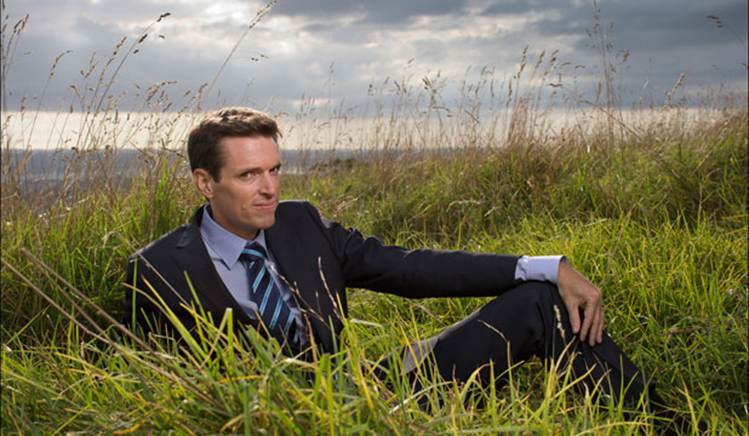
[Image description: This is a picture of Colin Craig lounging in grass for no reason. I’m not sure who to credit for the photo, and frankly I question whether they deserve credit.]
Looking across this loose web, I see more politicking than philosophical commitment.
The FSU will sometimes mumble lukewarm support for a ‘progressive’ issue – but most of their campaigns champion people who want to share anti-trans views, make offensive comments about race, or voice religious beliefs that marginalise others. And they’d deny it, but just like Judy wields her secularism mostly against Māori, the FSU seem to imagine a world in which different people deserve different levels of protection for their free speech. For example, in their submission on a Law Commission paper, the FSU argued against regulating hate speech, on the grounds that:
The Report [of the Royal Commission] lays the foundation for proposed law reforms influenced by moral panic and a knee jerk legislative response... An emotional reaction can create a distorted view of the true scope of the threat, leading to overreaction in the form of broad and imprecise legal measures that are unlikely to be effective in preventing future incidents.
But if some people just need to harden up about racism and terrorism, others need a bit more cotton wool. In the same submission, the FSU argued against using te Tiriti (in te reo) over the Treaty (in English) when there are discrepancies, because of diddums-widdums:
Prioritising one version inherently privileges a specific linguistic and cultural perspective potentially marginalises viewpoints grounded in the English text … Scholars, lawyers, and the public may feel constrained in debating the meaning of Te Tiriti for fear of backlash or accusations of undermining Māori rights.
I get the impression the free speech political agenda knows which side their bread is buttered – and maybe it’s white bread they like best. One more story, and you can judge.
In 2023, the FSU went into bat for Julian Batchelor of the Stop Co-Governance group. Batchelor had put 550,000 pamphlets in the nation’s letterboxes and embarked on a national speaking tour. The Spinoff reports how he courted controversy, claiming ‘elite’ Māori were planning a coup, saying that teaching kids te reo is akin to child abuse, and likening the words “Kia ora” to “Heil Hitler”. When the inevitable happened and people reacted, you’d think a free speech fan like Batchelor would’ve taken it on the chin. He did not.
TVNZ ran a news item on Batchelor’s views, interviewing an academic named Dr Sanjana Hattotuwa, who commented that Batchelor was engaging in “extremely worrying” … “racist rhetoric” that “instigates harm offline”. Straight to court Batchelor ran, claiming he’d been defamed, and commenting that he had supporters with ‘deep pockets’. He testified to his hardship: thanks to the news coverage, he lived in tension knowing his neighbours didn’t like him, and had once overheard someone in a café call him racist.
It was only when the judge compelled him to answer that Batchelor admitted who was funding his case: the billionaire Jim Grenon. Grenon owns a stake in NZME, which in turn owns various newspapers and radio stations. After the TVNZ item aired, Grenon had rung Batchelor to suggest he sue. (This wasn’t the only help Grenon had given Batchelor. He’d also engaged Stephen Franks to support Batchelor when his pamphlets got him investigated by the Electoral Commission.)
TVNZ’s lawyer asked, “This is your case, Mr Batchelor. How much involvement have you personally had in running this case?”.
Batchelor replied with a refreshing honesty, “Very little”.
Just last month, and over two years after Batchelor commenced his legal action, the court released its judgement. It found that TVNZ’s reporting, including the comments by Dr Hattotuwa, was true. As the judge put it, “Mr Batchelor’s claim has been wholly unsuccessful”.
What did the FSU have to say about Batchelor’s case, and its potentially chilling effect on free speech? If they’ve made a single peep, I haven’t found it.
TVNZ and Dr Hattotuwa had won, but it was only a partial victory. The stress of a lengthy legal process takes its toll on anybody, especially a process backed by deep pockets. At least as importantly, it sends a signal to an already embattled media, academics, and anyone who might have the temerity to speak against racism.
But then the fringe right knows that, don’t they?
Judy, once a teacher, has an elusive past, but she’s easy to find in the present. She describes herself as a digital creator, although her ‘creations’ have a pitiful quality: AI caricatures of Māori, mostly, with Muslims sometimes making an appearance. She posts prolifically on Facebook, often several times a day. Her profile picture is a pōhutukawa.
If I had to guess, I’d say Judy emphasises her teaching credentials because she knows educators have a kind of authority. Put it this way. When Kev down the pub shares his reckons, about te Tiriti or trans people or co-governance or whatever, you treat them as just that: reckons. But when an educator does it? You’re more likely to think, Maybe there’s something to this.
When people put weight on your words, it’s a form of privilege – and it creates a responsibility to use those words wisely. This plays out in education, especially in universities and through the concept of ‘academic freedom’. Academic freedom is one aspect of the free speech debate, but what is it exactly? We can’t go into detail, but let’s take a glance.
In Aotearoa, our Education and Training Act 2020 gives staff and students the right “to question and test received wisdom, to put forward new ideas, and to state controversial or unpopular opinions”. There’s a bunch of nuance here – but for our purposes, academic freedom protects quality speech, not any old stuff like our Kev might say over a pint.
The thing is, academic institutions also have to meet the ‘highest ethical standards’. At a basic level, this means academics shouldn’t go around saying dodgy stuff – in their work, and sometimes their personal, lives. They should talk with integrity, drawing on evidence and logic, not just make stuff up; and while they shouldn’t shy away from controversial ideas, they shouldn’t be dicks for the sake of it.
Anxiety about academic freedom is an international phenomenon, and the free speech political agenda talk about it a lot. Here, I apologise in advance. We just untangled a web, and now we face an even bigger one. Before we start, I’ll say it again: it’s not that the free speech political agenda always make bad arguments. It’s their intent and their tactics I question.
It’s hard to say when anxiety about academic freedom began, but a couple of recent moments can help us understand it, then connect it to Aotearoa. First, let’s look at a well-known 2018 book called The coddling of the American mind. I’ll simplify here to keep it easy – and to help you spot some familiar themes.
The coddling of the American mind makes the not-very-original claim that kids these days are soft, but it adds a new twist: ‘emotional safety’. Parents, and then universities, try to protect kids from the discomfort that comes from challenging ideas. More and more, lecturers teach what students want to hear, not what they need to hear. Campus life is all safe spaces, trigger warnings and oppressive speech codes that stifle debate. And because students can no longer handle challenging ideas, they respond by calling people out or shutting them down. The result is an anxious, unhappy, non-resilient generation.
The coddling of the American mind has been influential, but influential doesn’t equal good. Some critics think its authors cherry-picked a few events in the US, slanting them a bit and then overblowing them into trends.
One co-author of The coddling of the American mind is a dude called Greg Lukianoff. He’s also chief executive of something called the Foundation for Individual Rights and Expression, or FIRE.
FIRE is a US lobby group funded by wealthy conservatives. Its website feels like bad PR, including strawman arguments that free speech didn’t actually cause the Holocaust, and a ‘documentary’ in homage to Charlie Kirk. The PR is uncomfortable, but there’s an honesty to it. The thing that irks me is FIRE’s ‘research’.
This is overseas stuff. You could read about it and wonder, Who the hell cares? I’ll tell you who cares. It’s the fringe right in our own backyard, that’s who.
In Aotearoa, a report on our alarming decline in academic freedom keeps popping up, like it’s gospel. I thought I’d take a look. The report’s called Unpopular opinions: Academic freedom in New Zealand, and it’s by The New Zealand Initiative, a right wing thinktank. It’s long with fancy graphs and stuff, and maybe seems impressive – until you lift the lid. I think you know where I’m going.
Unpopular opinions starts with a claim that academic freedom is threatened worldwide, and that the threat’s coming here, like a kind of contagion. That sounds worrying, but a big claim must have big evidence behind it, right? I began to scan the references.
The coddling of the American mind? Tick.
FIRE and its bloody awful ‘deplatforming’ data – data that counted, or failed to count, all sorts of strange stuff, making it look like the left is cancelling conservatives en masse? Tick. Hmmm.
But what evidence does Unpopular opinions actually offer about Aotearoa?
Bugger all, as it happens, despite its many pages. Short ‘testimonials’ from irritable academics that leave you pretty sure there’s something they’re not telling you. News stories. And most troubling? An ‘academic freedom survey’ by the FSU, carried out by Curia Market Research. RNZ has reported how this survey was called misleading, with even Curia warning about its objectivity. Eventually, the FSU took the survey down, but Unpopular opinions used it anyway.
I don’t want to get methodological on yo ass, but accuracy matters. There’s almost no reliable evidence on academic freedom in Aotearoa: official documents say as much. But the truth is both boring and hard work to decipher. Easier to turn poor international research into poor local research – then turn both into soundbites.
Newsroom reports how some believe the FSU borrows other countries’ approaches to bring culture wars to our shores. Associate Professor Sereana Naepi and Emeritus Professors Peter Davis, both kiwi academics, have called our own panic about academic freedom a ‘manufactured crisis’. They stop short of speculating who might gain from such a crisis, and so will I.
I’ll just say this. Across the world, misinformation, disinformation and mischief are already powerful enough. When they seem like they’re backed by experts such as educators, they become monstrous.
On that unhappy note, let’s keep going.
Every FSU email disturbs the serenity of my inbox, and in recent weeks those emails have taken a turn.
That’s how this piece began. I noticed the FSU had begun campaigning against health workforce regulation. Does the free speech political agenda have a new cause, I wondered? I started searching the fringe right web we met earlier – and that’s when I first noticed Judy.
After that, it seemed like her pōhutukawa picture was cropping up all over the place. Each time, I felt seedy at the content beneath it. Still, one particular incident made my jaw drop. Judy had tried to make an anonymous post on a community Facebook page, but was caught by the admin. The attempted post said:
Fk your "partnership"
Fk cogovernance
Fk the iwi descendents murderers and cannibals
It’s amazing what some people will say when they think they’ll never be held accountable.
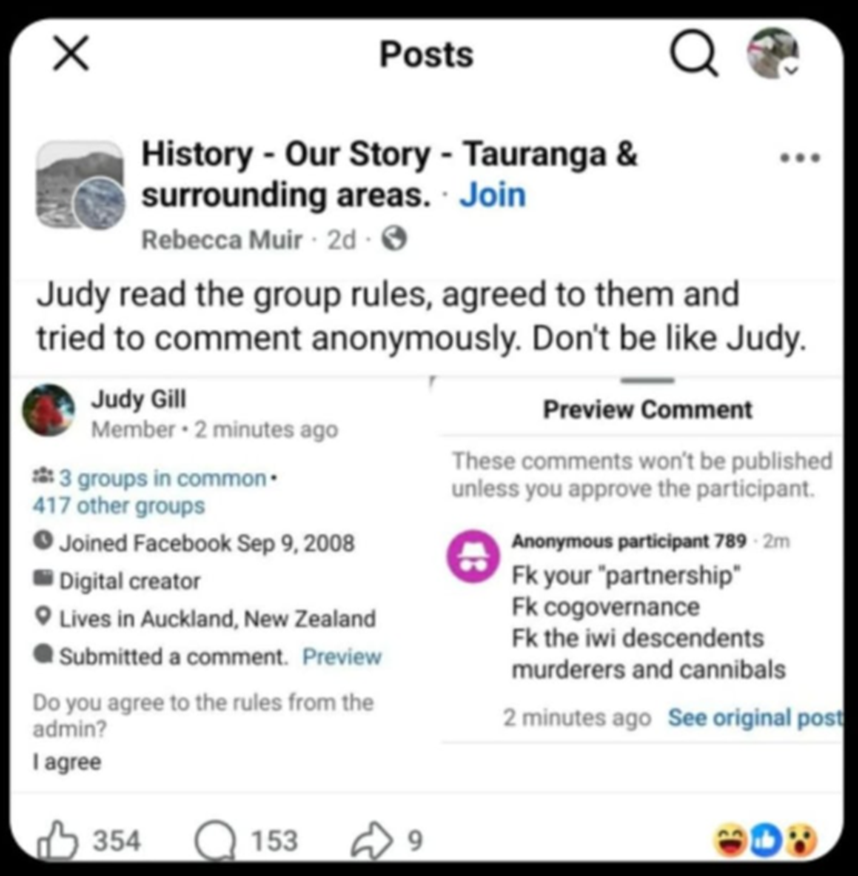
[Image description: Judy’s attempted post abusing Māori.]
To come back to health workforce regulation – what is it exactly? In short, the public needs to know health professionals meet certain standards. Organisations like the Nursing Council and Medical Council set those standards and deal with health professionals who don’t measure up.
When I saw the FSU wade into health workforce regulation, I wondered at their credentials. I was surprised. Here’s an aside.
One FSU council member, Roderick Mulgan, is a medical doctor. Dr Mulgan also owns a business that describes itself this way: “At Lifeguard Health, developing what we call 'life-saving technology' is quite simply at the heart of everything we do”. I combed the Lifeguard Health website looking for this life-saving technology. All I found were bottles of capsules with ingredients like “passionflower” and “pine bark”.
What’s going on?
Capsules probably make you think of medicine. Medicine has rigorous science behind it, and tight rules around advertising. But Dr Mulgan’s capsules are dietary supplements. Dietary supplements generally aren’t much use – Health New Zealand recommends spending your money on decent kai instead. But dietary supplements count as food, not medicine. That means they fall under different rules, and sellers can make different kinds of advertising claims about them. The Lifeguard Health website uses words like “evidence-backed” and talks about health problems like arthritis, heart disease, dementia and cancer. It says its products are “doctor-formulated” with “trusted GP oversight”. Everyday people, who may not understand science or know there are different sets of rules, are left to figure it out.
I digress, but not that far. When health professionals speak, we tend to assume rigorous science. That’s one reason why careful speech matters. Back to health workforce regulation.
FSU stories about nurses keep appearing in my inbox: nurses who’ve taken to social media to share their views on vaccines, COVID, rainbow people, abortion, gender identity and Te Pāti Māori. All have got in trouble with their employers or the Nursing Council. The FSU has not only gone into bat for these individuals, but launched a campaign against the code of conduct that the Nursing Council applies to nurses, and which limits their speech. To paraphrase the FSU, “offensive, abusive, inflammatory or ill-informed” language is too hard to define – and anyway, what nurses say off the clock doesn’t affect their ability to do the job.
Of course, judging what counts as offensive, abusive, inflammatory or ill-informed is tricky – and that’s why nurses alleged to have broken their code of conduct go through an investigation. But why shouldn’t nurses be able to say the same stuff as ordinary people, like Kev down the pub?
The answer isn’t wokeness. It’s science – and I mean actual science.
Racism is an undisputed cause of health inequity. And homophobia. And transphobia. When it’s not done well, healthcare contributes to inequity. Anyone who says otherwise is talking rubbish.
I mean, think about it. Say you know what that person in the consult room thinks about ‘your type’. Do you tell them that you’re struggling with your weight, or your mental health, or alcohol? That you’re not sure if it’s safe to get your kids vaccinated, and you just need someone you trust to level with you? That you want an STI test? Do you let that person give you a cervical smear or a prostate exam?
Or do you burn with shame and find another reason to put off your appointment?
One FSU email about nurses, sent by Dr Mulgan, contained a ‘satirical’ online tool inviting me to enter my thoughts, opinions or jokes to see if they’d comply with the Nursing Council code of conduct.
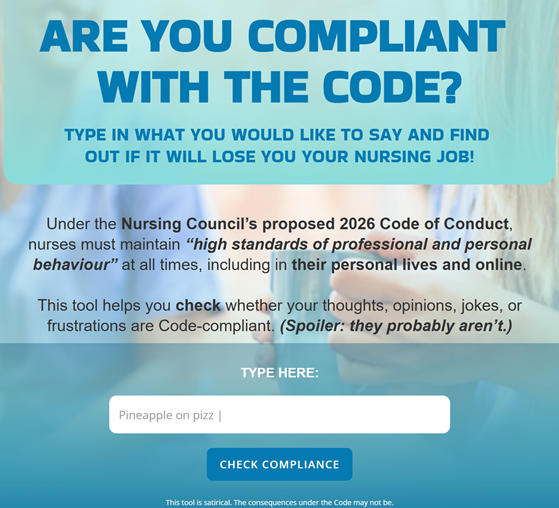
[Image description: A screenshot of the so-called satirical tool.]
I did exactly what the FSU intended, entering into the tool the most offensive word I could think of.
In response, the tool warned me flippantly that someone, somewhere, might find this word ‘unprofessional’ – then tried to make me feel aggrieved at the absurdity of that, as if typing a cowardly, anonymous slur made me some sort of martyr or hero.
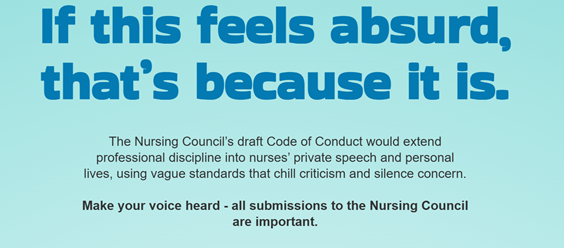
[Image description: Another screenshot of the so-called satirical tool.]
Why would the free speech political agenda set its sights on health workforce regulation? There are a few reasons, I reckon.
The health system is a pillar of the public sector – and one that most people, no matter how they vote, still feel an allegiance to. Weaken that pillar, and you weaken the state. Added to that, health workforces tend to be unionised. Weaken that, and you weaken workers.
But I think it’s something more.
Health professions, and other professions, don’t make the right decisions every time – including when they regulate their own. They can get self-serving or cosy, or have egotistical spats. But they also, at their best, resist the tactics. They refuse to be seduced by the neat answer, or to reduce the world to a rule of thumb, to the lowest standards. Instead, they deal every day in the grey: in the consequences of underfunding, misinformation, poverty, colonialism and discrimination. And they try to make it better.
Health professions are some of the last holdouts against the world imagined by the free speech political agenda: a world in which there are no values, no virtue, no thinking before you speak or caring for the consequences after. You can see why codes of conduct are a problem for the fringe right.
It’s another crisis just begging to be manufactured.
It seemed odd to me that Judy still relies on her teaching credentials. She trained and taught way back in the 1970s. Nowadays she’s retired. She does the rounds of the fringe right web we talked about, appearing on The Platform, the NZCPR website and even Whale Oil’s blog. Yet almost four decades of her life seem unaccounted for.
I have a theory as to why.
You could say it started in 2003. Dr Judith Gill owned and operated two medical practices in Auckland. She first hit the news for sacking an employee who’d reported missing money to police. The matter went to the Employment Relations Authority. The ERA said Dr Gill had treated it with contempt and ordered her to pay $14,000.
What the sacked employee had or hadn’t seen, I can’t say – but in 2008, Ministry of Health officials raided Dr Gill’s office, seizing some 30,000 patient files. Dr Gill fought back with a lengthy legal challenge to prevent the Ministry using the files against her. And she had some success. It wasn’t until 2010 that the courts confirmed the warrant to raid her office was lawful. The Ministry’s investigation resumed.
In 2015, Dr Gill was charged with 165 counts of receiving subsidies for patients who weren’t eligible for public funding, or weren’t in the country. Many were backpackers who’d merely visited Aotearoa. All in all, Dr Gill had improperly claimed $420,000 in relation to 2,618 patients.
Whatever happened next took place behind closed doors, but Dr Gill never went to trial. She made a confidential settlement with the Ministry of Health, and would later claim she’d paid back the money, although she provided no evidence of this.
And after all that? Well, Dr Gill was still a doctor.
In 2019, the Health Practitioners Disciplinary Tribunal laid a disciplinary charge against her. COVID caused delays, but so too did Dr Gill, asking for three costly postponements of her hearing. In 2022, when her day finally came, she didn’t show. The Tribunal heard how her improper claims had spanned 2003 to 2011 – which seems all the more extraordinary, since it includes the period during which the Ministry was taking action against her. The Tribunal found against her, censured her and removed her registration.
In a kind of irony, Dr Gill asked the Tribunal for name suppression, something the free speech political agenda hates. She was declined.
To be clear, I’ve found no evidence that Judy expressed her views on race while she was practicing medicine. And it doesn’t follow that Judy’s views on race are connected to her misuse of public funds – although you wonder if a disregard for other people underpins both.
But it’s her ex-patients I think of, and the betrayal they must feel, each time she posts.
We look to doctors as leaders in our communities. We invest greatly in their education because we understand they want to serve us. We share with them the most intimate and vulnerable parts of our lives; bring to them the people we love, from pēpi drawing their first breath, to kaumatua drawing their last. We trust them to touch our skin without reviling its colour.
You could say what’s inside a person doesn’t matter if it stays unspoken: no harm, no foul. Maybe. But the speech of professionals carries a special power, to help or to harm. Undermining professional codes decouples that power from responsibility. And when people do that, I question their intent and their tactics.
All I know is I want safeguards in place, the right decision-makers in charge, so I never have to see a doctor who talks like Judy.
FSU emails are frequent, but at least they’re short.
They often start with the story of a disgruntled someone. These stories are ambiguous – I can seldom figure out who did what exactly – but the language is striking. The police are lying. It’s ideological extremism. Authoritarianism is creeping. It’s a slippery slope.
Facts are sparse in these emails, and any links usually take me to more of the same: an echo chamber of FSU petitions or blogs. I get the sense I’m not meant to dwell on details. I keep scrolling, but I don’t have to scroll far.
By now I think I know how I’m meant to feel: invested in the story, like a vicarious martyr or hero. I reach the orange donation button. I suppose my emotions are meant to prise open my wallet.
When the FSU sold wine to fundraise, I was startled – did they seriously have supporters who’d spend $135 on a bottle? Then I realised I’d misread. The wine was $135 per case, and it wasn’t aimed at the powerful or fancy at all, but at folks like you and me.
Cheap wine’s a gamble, sometimes OK and sometimes not, but anyone who’s bought it knows something - and so, I think, do the FSU. Have enough of it to drink and you don’t care so much how it tastes. The feeling of intoxication is what matters.
Notes
The hands-down best discussion of hate speech I’ve found is by the Royal Commission of Inquiry into the Terrorist Attack on Christchurch Mosques on 15 March 2019. The Royal Commission shows exactly how hard it is to regulate hate speech – not just because it may impinge on free speech, but because depending on how you do it, it may create knock-on problems.
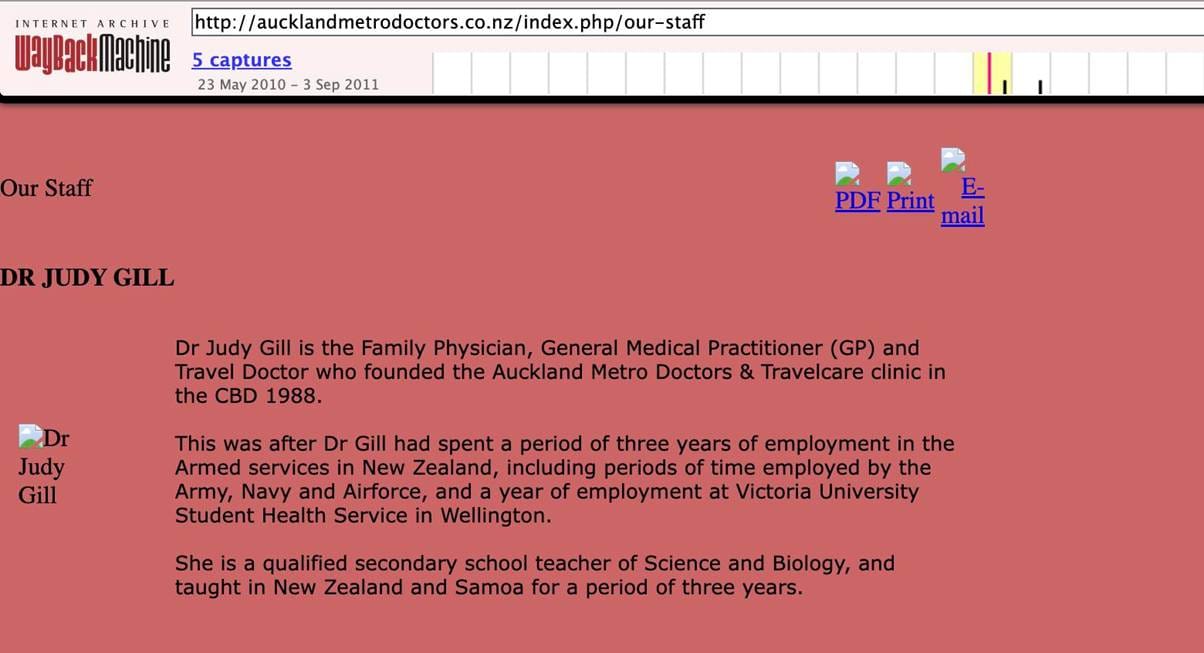
There are a few things linking Judy Gill to Dr Judith Gill, one of which is the below – credit to I am Brie Elliot for unearthing some of this evidence.
Other links about Dr Gill include the following:
The findings of the Health Practitioners Disciplinary Tribunal
Auckland doctor ordered to pay fired employee - NZ Herald
Doctor to pay for email dismissal - NZ Herald
Auckland GP faces 165 counts of fraud | Stuff
Doctor loses appeal over seizure of patient records | Otago Daily Times Online News
Auckland GP Judith Gill struck off after claiming $420k for backpackers who had left NZ - NZ Herald