Food in the mind

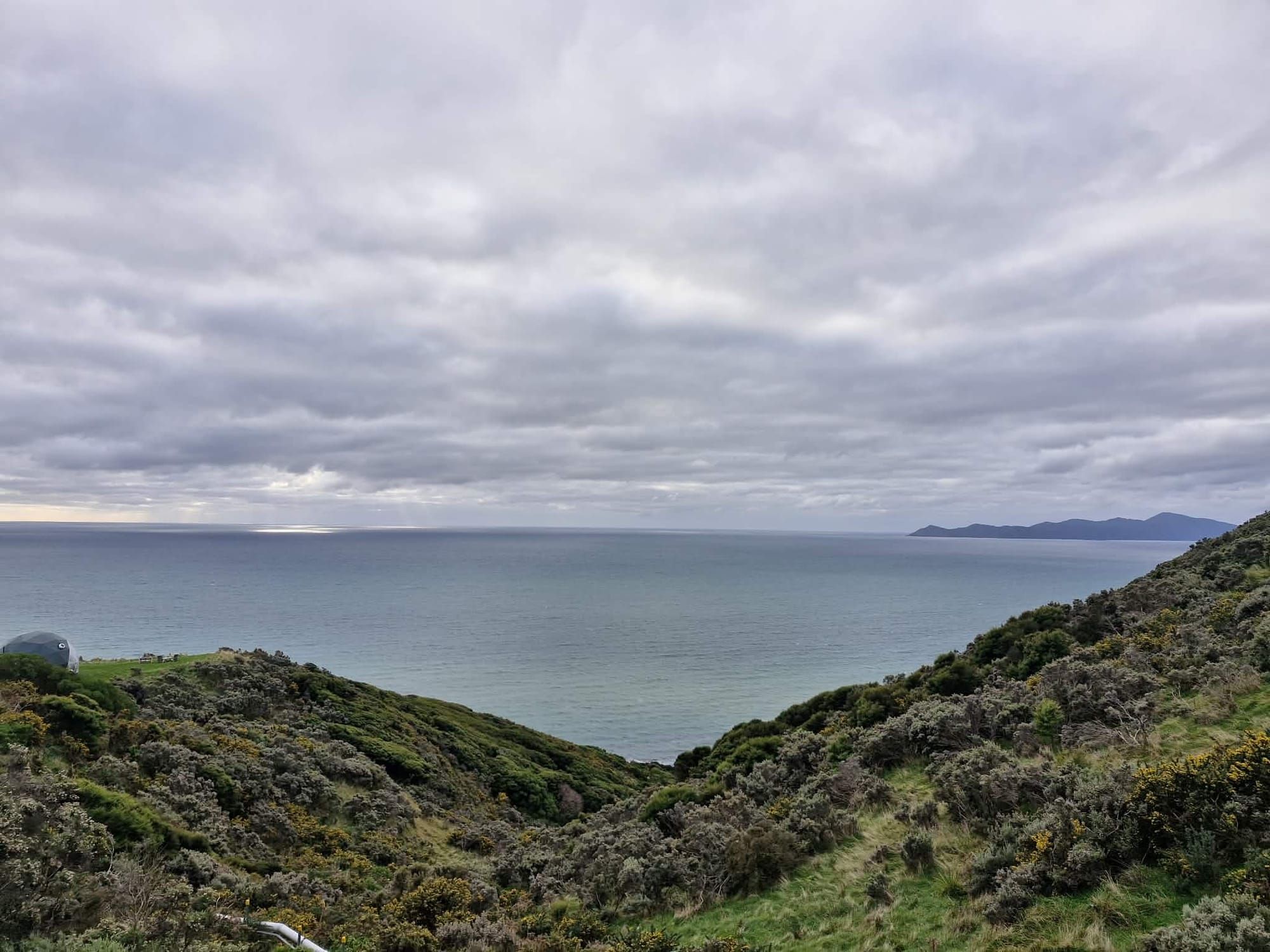
This post includes a vote of thanks to Lani, Hugh and Aaron of Pukerua Bay’s Escarpment Domes, who offer a residency programme to writers and artists – including very lucky me. The picture you see above is from my view this week out to Kāpiti Island.
You’ll sometimes hear folks like me say, “I’m not that kind of writer”, by which we mean there’s a hierarchy.
At the top of the hierarchy are writers of novels and serious non-fiction, like history books. In the middle are folks like me who mostly publish online. Lower down are the people who riff in Facebook posts. It’s like that in my mind, at least.
And there’s another overlay. I grew up with a healthy dose of cultural cringe still embedded in the curriculum, even when I made it as far as university English, and still embedded to an extent in my head. It’s embarrassing. Somewhere inside me, a voice is still whispering that if I just read Shakespeare I’ll be more smarter.
It’s not that any of these kinds of writing are undeserving – more that I’m easily intimidated. For these reasons, it’s never really crossed my mind to go to a writer’s festival. That was until I saw an ad for the Featherston Booktown Karukatea Festival 2026. Featherston’s only a half-hour drive from my house. It’s not very Shakespearean, but I thought, f*** it.
Even before I got long COVID and brain fog, I wasn’t much of a reader. My reading brain is like a greyhound: able to run down a topic when it needs to, but at other times, snoozing dorkily on the couch. This has secretly made me feel less smarter – everyone knows the one thing a good writer does is read – but it’s also forced me to find workarounds.
I learn from stories. Movies and TV. Podcasts. The way a pepeha works: place and relationships and imagery all wrapped up. New stuff I keep discovering: the Royal Family hip hop crew; Cain Culto, a queer immigrant activist rapper; and Bryan Andrews, an outlaw country artist. People who sit next to a mate on the train and tell them anecdotes. A workmate who made a PowerPoint presentation that was somehow improbably beautiful. Jokes. OK, Shakespeare a little bit. I’m not saying all stories are equal, or their tellers equally skilled. But every story has something to teach if you get under the hood and tinker with it a bit, just to figure out how it works.
Featherston Booktown didn’t look like it would be intimidating, but you can’t be too careful – so I wore my new Docs, in case I ended up stuck with a bunch of nice, cultured, whitehaired ladies from Karori, and I needed to signal I wasn’t one of them. In the end, I ended up rubbing shoulders with both the Karori ladies and other middle-aged women in boots similar to mine. If I needed a reminder of how edgy I’m not, this was it. I laughed at myself and figured it would make a good story.
Here are a couple of my Booktown highlights.
Cross Party Lines is a podcast featuring Phil Goff and Chris Finlayson, political opponents who come together on the issues of the day, or on whatever they feel like, because they can. Booktown featured a live recording of their show. It packed out Featherston’s largest venue, and it was nothing short of magical. These two are people who’ve reached the point in life they’ve discarded their filters alongside any remaining f***s, and feel free to violently agree with one another.
At one point, and I’m paraphrasing only a little, they spelt out the hateful tide of racism drowning democracies around the world, and they called it deplorable – not in the grey way of men who check their LinkedIn more than their conscience, but with something that felt like conviction or even rage. Finlayson said – and I paraphrase only a little – that he is a conservative liberal, and his offsider is a social democrat, and you can vote for either of those things, but you cannot vote for right wing populism.
It was extraordinary, and I realised I crave this: people speaking from principle, whether or not their principles are exactly my own. As Goff and Finlayson talked, the heads around me – mostly Pākehā and whitehaired – nodded to their words.
My second highlight was Tāme Iti. He and his son took the same stage as Goff and Finlayson a day later, packing out the same town hall.
Tāme has also reached a certain point in his life, and he talks like he prefers wisdom to words – the opposite to most things these days.
He took us to his boyhood in the Urewera, and to his awakening as a young man of 18 or 19 who could hardly articulate or even understand racism the first time he met it. Soon after, he was shoulder to shoulder with activists – and at odds sometimes with his own elders. He moved through stages of anger, from which he never resiled, but through which he grew; and in time, his activism became art and whakawhanaungatanga, and conversations with people not like himself in small towns not his own.
He called this food in the mind. Asked what kind of activism is better, smashing the system or making art, he grinned: “We’ve still gotta smash something”.
As he talked, the heads around me – mostly Pākehā and whitehaired – nodded to his words.
At question time, an older Pākehā lady rose to her feet. She did her best to greet Tāme and his son in te reo, and the kupu got tangled, but she kept trying anyway, even though it was hard, because the only people who don’t stumble are the ones who insist on standing still. She thanked the speakers, and she asked if we, the audience, could sing them a waiata before we parted.
A few weeks before, my own son and I had been talking in the car. He told me how he was reading Struggle without end by Ranganui Walker – something suggested to him during a Treaty training with stories that had captured his imagination. I listened to my boy and I couldn’t hide my delight. Tāme, after his talk, sat at a desk to sign his book. It occurred to me I’d love to give that book to my son, and so I bought a copy and joined the queue to get Tāme’s autograph inside the cover. I had in mind that I might ask him for a photo too, but as the line inched forward, with Māori readers grasping both his hand and his whakaaro, and older readers introducing their mokos to him, I understood that others needed his time more than me.
I don’t always have a lot to say about literature, but I do know this. We live in a post-truth world; but even before all of that, humans never loved facts. Facts matter, but they don’t move strangers to sit together in a town hall, listening and nodding to someone they’ve been told for a lifetime they should fear, reject or hate. Stories of whatever kind, high or low, are better for the job.
Before Tāme’s talk had finished, and we all sprawled outside into the afternoon, we did as the lady asked and rose to our feet for Te Aroha. It surprised me when the sound of us lifted to the roof.
I worried we would not know the words of the waiata, but it seemed that somehow everybody did.