Friends in low places

To be clear, I’m not accusing anyone of wrongdoing – but I believe I’ve stumbled into a system problem, and there’s nowhere to take it. For privacy and safety reasons, I’ve only given people’s names where it’s necessary to the narrative.
I have a bonkers story to tell you – and the first chapter isn’t even the bonkers bit.
To recap that first chapter: last year, during the local government elections, I took part in the campaign of a mayoral candidate in Upper Hutt. As the campaign unfolded, the women involved, including the candidate, were targeted by a man called Graham Bloxham. Mostly it was social media posts and emails, sent not just to the targets themselves, but their past employers, local businesses, members of Parliament, the national media, the police and more. The emails were abusive, cruel and untrue. Sometimes they were disturbing. One mentioned a target’s children. Another mentioned firearms.
Bloxham was (and is) a vocal supporter of Wayne Guppy. Guppy was Upper Hutt mayor until last year, when he lost the election. In late August and early September 2025, the period when Bloxham was targeting people, Guppy’s election campaign also moved up a gear. His Facebook sprang into life – but it had a suspicious illiteracy about it. Facebook users assumed Guppy and Bloxham were working together, and they were unimpressed. After all, Bloxham’s behaviour had been well-covered by media. He even had proceedings against him under the Harmful Digital Communications Act 2015.
Now the media began to probe. Questioned by The Post, Guppy said Bloxham wasn’t involved in his campaign. In the same article, Bloxham said the opposite: he was involved, but off his own bat. He’d change his tune later and deny involvement, but it didn’t seem to shift public opinion. Even Guppy’s Wikipedia page suggests his association with Bloxham helped cost him the election.
I was dark about the association then, and I’m still dark now. Call me old-fashioned, but I expect better from leaders. During the campaign I even emailed Guppy, telling him what Bloxham was doing and asking him to cut ties. I never got a reply.
In the thick of the campaign, I was too busy to pay much attention to Guppy’s Facebook posts. I figured it’d all come out in the wash – Guppy, like every other electoral candidate, would have to complete a candidate return in the months after the election, showing donations and expenses.
When the campaign was over, I remained almost as busy. I started work on a book trying to process what the hell I’d just been through. Aotearoa, like many places, has a problem with harassment – including the serial harassment of political figures. My book tries to understand harassment, why people do it, and perhaps most importantly, how they get away with it. Writing means research, and I started making official information requests. Those have a way of turning up things you weren’t even looking for.
What follows is a matter of record, information that is either publicly available or provided in an official capacity. I’ll do my best to let the information tell its own story.
We’ve made it to the second chapter. I’m going to talk you through three incidents. I can’t tell you if they’re breaches of the electoral rules – the legislation is infernally hard to understand, and I’m no lawyer. Even if they were breaches, I’m not suggesting bad faith was involved. Mistakes happen. All I’m saying is my concerns raise important issues that deserve a hearing. Here goes.
On 28 August 2025, a video appeared on Guppy’s Facebook page. In it, Bloxham sits beside Guppy, filming him as he drives. Bloxham asks Guppy questions like, “Can Upper Hutt take any more success?”. (We probably could, to be fair, but that’s a story for another day.) The video is promotion, not journalism, and was never picked up by the mainstream media. It was posted on Guppy’s Facebook page with two campaign hashtags: #voteguppy, and #paradisevalley, which never caught on.
On 31 August 2025, a second video appeared on Guppy’s Facebook page. In this one, Bloxham is at Upper Hutt’s Brewtown market. He interviews a member of the public about his support for Guppy. Guppy’s campaign slogan, Dont mess with success, is added into the video – clearly by someone happy to mess with punctuation.
A third incident came my way unexpectedly through an official information request. On 25 August 2025, Guppy used his mayoral address to send Bloxham an email with the subject line ‘Speech’ and a campaign spiel attached. Three days later, on 28 August, Bloxham emailed Guppy back with the subject line ‘Brichure’. He attached an election flyer he’d designed using the language from Guppy’s campaign spiel.
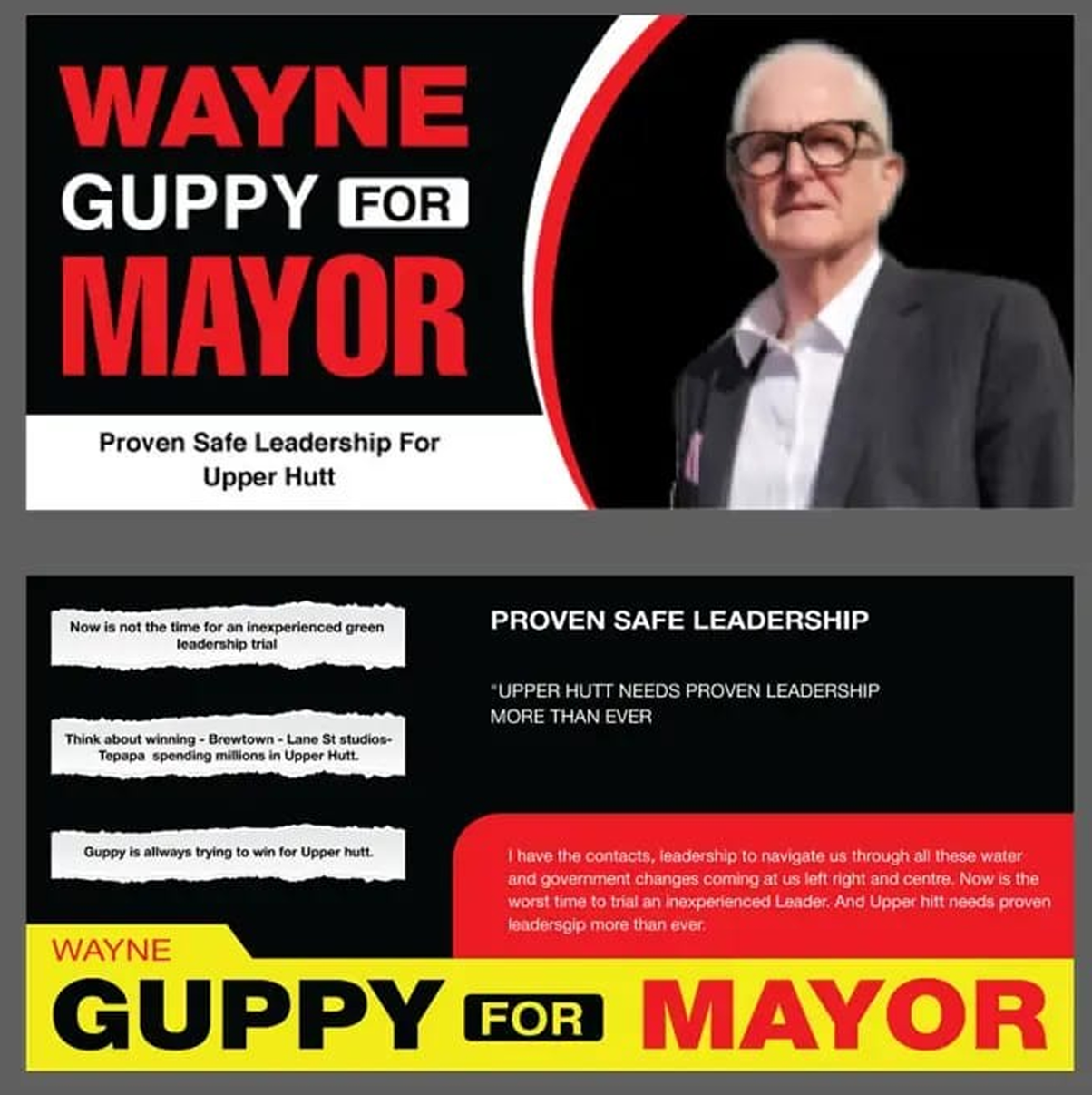
[Image description: This is the brichure, and it’s quite the brichure. In the end, Guppy went with a brochure. It looked pretty similar but had better spelling.]
OK. I don’t think these three incidents show good judgement – particularly using the mayoral email to send campaign materials. And it’s hard for me to understand how two people could film themselves in a car and say they’re not working together. But what matters is that a candidate’s return reflects the donations they received and the expenses they paid for their campaign.
Looking at Guppy’s return, Bloxham and his media business are nowhere to be seen. Like I say, I don’t know if this is against the rules. Maybe it’s within the rules, and the rules themselves aren’t up to scratch. Either way, I’m determined to ask the question.
It’s chapter three, and I apologise in advance for a bit of faff. We need to delve briefly into some electoral stuff. You’re on the edge of your seat, I know. Stay with me.
People assume local government elections run much the same way as general elections. Surprisingly, they don’t.
General elections are overseen by the Electoral Commission. It responds to complaints in ten days, and it refers complaints with substance, often to police. There’s transparency. People can make official information requests of the Electoral Commission, or complain about its processes to the Ombudsman.
Local elections are different. Each council appoints its own electoral officer. But councils are often small, busy and short on money. The Local Electoral Act 2001 lets councils contract out the electoral officer job. Most councils do, to one of two private businesses. And here’s the kicker. You can’t make an official information request of an electoral officer, or go to the Ombudsman – even though electoral officers have serious powers under the law. In some narrow situations you can ask the District Court to get involved, but at your own expense.
In short, if you’re worried about a local government election there’s not much you can do about it.
That’s how the rules are enforced, but what are rules themselves?
The Local Electoral Act 2001 is a mishmash of stuff, but it includes electoral donations and expenses. It says candidates must declare their donations and expenses in a return. If their return is “false in any material particular”, it’s an offence – unless they can prove they didn’t intend to mislead or conceal the facts, and that they took all reasonable steps not to.
But what does it mean to declare donations and expenses? This is where it gets tricky. I’ll do my best – and bear in mind I’m not a lawyer.
Donations aren’t just about money. The Act says a donation:
… means a donation (whether of money or of the equivalent of money or of goods or services or of a combination of those things) that is made to a candidate, or to any person on the candidate’s behalf, for use in the candidate’s campaign for election.
Say you’re a candidate. I own a print shop, and I like the look of you – so I print your billboards for free. The value of those billboards counts as a donation. If all my donations to you add to $1,500 or more in value, you need to put them on your return, and you need to name me as the donor. Without this rule, candidates might find ways to sneak extra funds into their campaigns.
Expenses aren’t just about money either. The Act says an expense:
… includes the reasonable market value of any materials applied in respect of any electoral activity that are given to the candidate or that are provided to the candidate free of charge or below reasonable market value.
In our example, when you put up the billboards I printed for you, their dollar value counts as an expense (not just as a donation). Expenses over $200 have to go in your return. Local government candidates have caps on how much they can spend – and if the value of donated stuff didn’t count, candidates could use donations to get around the caps.
My explanations make this all sound simple. It’s not. How do you judge the value of goods and services? How do you tell a service with money value from volunteer labour? I’m the first to admit I’m not qualified to say – but I’ll make one point. Bloxham owns a media business. His goods and services, like videomaking, have a dollar value: he sells them for a living.
Guppy and Bloxham have a longstanding business connection. Guppy’s return for the 2022 local government election shows he spent over $9,000 with In Your Pocket, Bloxham’s media business, for services like managing Guppy’s Facebook page. My official information request accidentally uncovered a sequel to this connection. On 28 November 2023, Bloxham sent Guppy what looked a funding request for Wellington LIVE, Bloxham’s Facebook page. It included:
Mate, Im about to throw U/H under the bus in our 1M follower base.
I run a Upper Hutt community page, FREE with all negative attacks moderated. We are positive about your facebook page even if they are shifty toward us.
I'm really pissed off U/H treat me and Wellington live like this, 0 budget, 0 engagement and 0 respect.
We even moderate negative comments in our communities about Upper hutts drug problems and violence.
I'm about to completely kick U H for touch!
And that extends to all coverage, moderating negative comments, letting negative comments become visable again, my writers do stories about U/H that aren't as amazing as you would like.
If U/ H keep ignoring us and treating us like shit I'll turn it all off completely and wipe my hands of it!
Bloxham signed off, All the best for the silly season. Blox. Guppy replied, I will catch up and phone you.
I have no idea what happened next. I’m just glad the secret that Upper Hutt does drugs never came out.
We are now at chapter four, and believe it or not, this is actually the point that the bonkers begins. It’s also the moment I go bit bonkers myself.
I’ve got questions about Guppy’s return, but I’m not qualified to judge. The person to talk to is the electoral officer – employed by one of the two private businesses that run elections for councils. I reached out to him the weekend before last. In what follows, we’ll call him The Officer.
In case you wonder, I let The Officer know twice that I’m a writer planning to publish. I asked him several times to correct anything I might’ve misunderstood. Somehow, this is where things landed. Here we get to the real story – not my concerns, but the way they were handled.
On Sunday before last, I sent The Officer the issues I’ve raised in this piece: the three incidents, clear evidence they happened, and the parts of Act with the election rules I thought had possibly been breached. I was careful to flag Bloxham’s behaviour. I could have gone to police alleging an offence, but it seemed like a sledgehammer to crack a nut. I wanted The Officer to help instead.
On Monday, I got this back:
This question has been asked of me previously (earlier this year), which I referred to Mr Guppy. He has advised that he did not engage Mr Bloxham for those services.
If Mr Bloxham’s carried out those activities, they will have been at his own discretion, and not part of Mr Guppy’s campaign.
The course of action for anyone to take it further is to make a complaint to the Police, who will then determine if there is a case to investigate further.
My eyebrows raised. I couldn’t tell if The Officer had actually considered my evidence, or just dusted off his answer to someone else’s question. I’d raised the brichure – new evidence. And was talking to the candidate the sum total of The Officer’s investigation? What was meant by ‘if’ the activities were carried out? The activities were on film and in writing.
But the engagement comment bothered me most. I mean, I’m sceptical the incidents I’ve set out happened without some kind of advance arrangement – one doesn’t open one’s car door, find Graham Bloxham filming, and just decide to roll with it. But that’s a red herring. The Act doesn’t talk about ‘engagement’ in relation to expenses and donations. It’s not whether a candidate asks for services, but whether he accepts them or uses them. Surely that’s what makes a donation or expense – otherwise, there’d be a loophole you could drive through, maybe while being interviewed.
All I wanted was to know whether the video and brichure counted as donations and expenses. Had I completely got the wrong end of the stick?
I replied to The Officer. If he’d considered my concerns before deciding, could I request his reasoning why? That way, I figured, I would know if he’d looked at my actual question, what counts as donations or expenses, and weighed it against the right parts of the law. He insisted on a phone conversation first. I sighed but agreed, and on Tuesday afternoon we took the call.
How the legislation works, The Officer explained, is that the electoral officer just has to collect, review and check candidates’ returns: nothing else. I was now so confused that when I tried to talk, random syllables came out. The Act says the duties of an electoral officer include investigating possible offences. Isn’t phoning a candidate, then deciding there’s been no breach, a form of investigation?
More than that, as I said to The Officer, the Act places a duty on the electoral officer to report complaints he’s received about offences to police. “Not really”, The Officer replied. He explained that the public can report offences themselves, so there’s no point him doing it too. He’d only be forwarding other people’s emails.
I have issues with this: so many issues. The first, most obvious, is that the law doesn’t care whether you see the point of it. Another is that a report from an electoral officer isn’t the same as a report from the public. Police will take one more seriously than the other. At least as important, the public may not want to report direct. They might be scared, uncertain, or have challenges that make reporting hard. They might – hear me out – have better things to do than read electoral law.
I was taken aback. I told The Officer I’d summarise our conversation for him to correct. On Thursday, he replied to my summary.
The good news was this: The Officer conceded, “s138 of the LEA, duty to take action in respect of offences, does require me to forward complaints where an offence has been committed to the Police”. He’d realised his mistake. The bad news was he hadn’t fixed it. A mistake can affect public confidence. People may wonder if it’s a one off or a system problem – and in this case, whether others have felt discouraged from making complaints. Mistakes happen, but in my book, the mistake-maker needs to front foot something like this, especially if they’ve got a statutory job.
There was no front footing, but only worse news. The Officer said he’d taken some time to investigate this matter further. He’d concluded, I do not believe there is sufficient evidence that shows an offence having being committed. What was that investigation? He’d rung the candidate again.
Now I was shocked. I’d assumed I was talking to The Officer in confidence. If he’d asked me whether he could share my concerns, I would’ve said no – at least until I understood the process. I’d already flagged Bloxham’s behaviour to The Officer. The sensitivities were obvious. And anyway, the phone call had only led back to the same red herring: Guppy hadn’t engaged Bloxham for the services. Also, no, I wasn’t allowed to see how The Officer had made his decision. As he reminded me, electoral officers aren’t subject to official information requests.
It’s hard to type with your head in your hands, but I gave it my best shot. On Friday, I had one more go at explaining why I thought The Officer’s engagement point wasn’t a thing. What matters is whether the videos and brichure count as donations or expenses under the Act, so should have been declared – that was my concern.
The Officer said he hadn’t specified any “engagement point” in relation to the difference between expenses or donations. He said:
It is up to candidates to determine whether something is an expense or a donation, and to how that is treated, and it is not my place to check the validity of that… As I have mentioned before my role to collect and collate [returns], end of story.
Not his place? What had happened to his investigation powers – the ones he’d used to conclude there wasn’t evidence of an offence? Had they gone the same way as my will to live?
But at least we’d established The Officer had a duty to report alleged offences to the police. Hadn’t we? The Officer asked if I wanted to involve police, then advised, My preference is for you to go direct.
But we weren’t done. On Saturday, engagement was back with a vengeance, and so were those investigative powers. This time:
Ultimately its not my call as to whether an offence has occurred … but my view is that there is insufficient evidence to prove that Wayne engaged Mr Bloxham. Yes, he may well have discussed this with him, but Wayne advises that he chose not to contract him on his campaign, and therefore there is no expense nor donation to declare.
Ah well. I now had a definition of donations and expenses: just not one from the Act. I know when I’m beat.
Like I said, I told The Officer twice that I’m a writer planning to publish. I want to underline that I think he’s being unclear, not acting with ill intent. I asked him several times to correct me if I’d misunderstood. If he’d made any other mistakes, it seemed only fair to give him a chance – but he was adamant. And no authority can double check him. The District Court, the only possible safeguard, has no power in this situation.
By now, I could no longer tell up from down or left from right. I was just glad it was the weekend.
If chapter four wasn’t great, chapter five is the final kick in the pants. There’s a reason I wanted my concern kept in confidence.
As well as making social media posts and sending emails, Bloxham is a prolific sender of texts – angry, derogatory, and to anyone at all. On Saturday, one of those texts came to my attention. In it, Bloxham was furious. He ranted that someone had called the electoral officer on him, claiming he’d run Guppy’s campaign.
My heart sank. I can’t say for sure how Bloxham got wind of this, if it’s anything to do with me, or it’s simply a rant. I’m sure The Officer said nothing. But if someone told Bloxham he was under scrutiny, they would have known exactly how he’d react. Bloxham’s text listed the people he thought had dobbed him in. On that list were people he’s already targeted many times over, and amongst them, the women who’d served on the election campaign with me.
I’d been on the fence, wondering whether to hold this story for my book. When I learned my concerns had been shared without asking and my campaign friends were back in the firing line, when I felt the same seediness I’d felt during the campaign, I realised it didn’t matter. As women, we can wait patiently, pliantly, for the rules to protect us: wait and wait and wait. But I was done waiting. There was nothing left to lose.
How many people would persist through the experience I’ve had? How many would question an electoral officer? How many would ask how the law had been applied, or read the damn law to frame their question in the first place?
How many would stop trying? How many already have? Remember, I wasn’t the first person to ask about Guppy’s return. That person got the same message as me: there was no engagement between Guppy and Bloxham, so there was no problem. Perhaps they were also told that if they wanted to take things further they’d need to go to police themselves. I can’t say.
And this isn’t just a problem for the public. Candidates themselves, including Guppy, need good information to guide their choices.
Ultimately, there are even bigger questions. A vital part of our democracy, its checks and balances, is contracted out to private businesses with little oversight. Private businesses need to hold on to their contracts. When an electoral officer receives a complaint, especially about someone they might have worked with for years, what’s their incentive? Can you reasonably expect someone to rock the same boat that they depend on?
I haven’t explained exactly how Guppy and Bloxham worked together in the campaign – and nor have they, although the public record has offered many opportunities. Perhaps that matters less. I just want to know something more straightforward: whether the videos and brichure count as donations or expenses. If the electoral officer can’t or won’t tell me, who will?
A book is a big task. I know I need to get back to mine, putting this piece aside, and keep asking the questions I’ve set myself: why people harass and how they get away with it. I haven’t yet found my answer. All I know is they’ll harass as long as the system lets them.