Four and a half kilometres of happiness

This piece builds on some cracker reporting by The Spinoff. If you can, consider supporting them financially.
In the year of Our Lord 2025, for reasons I couldn’t quite put my finger on at the time, Wellington lost its shit.
A series of dirty politics scandals marred local government in the run-up to the elections. Then-mayor Tory Whanau became the target of a vicious misinformation campaign, with RNZ publishing a rumour she’d been captured in embarrassing footage no one had actually seen. The Platform embellished the rumour to include a lewd act that Whanau never committed. Social media said what The Platform actually wanted to, piling on with racist and misogynist abuse. Councillor Ray Chung was outed as part of the campaign against Whanau, having emailed his council colleagues a different rumour that Whanau had shagged Chung’s neighbour’s son.
Chung belonged to Independent Together, an electoral ticket for right-wing candidates. Independent Together was busted when their associate, a well-known anti-trans campaigner, hired a guy to build a dossier on left-wing candidates. In the words of The Post, the dossier was “like a culture war manifesto ‒ cherry-picking identity-related content, student-era activism, and Facebook photo captions to paint candidates as ideologues and radicals”. It even made fun of a candidate’s appearance and discussed his partner and children.
I’m sorry, Wellington, but 2025 wasn’t our best work.
Looking back, this cauldron of local weirdos had been bubbling for a while. It wasn’t just a Wellington thing: people all around the country were angry with local government. And there were reasons to be mad. Rates kept climbing while assets kept crumbling. But it felt like things got out of hand. The Three Waters reforms were meant to help, but stirred up bigots and cookers. Wellington’s problems were particularly acute, and so was our anger. We were losing our shit literally: in 2019, a wastewater pipe collapsed under Willis Street, sending up to 100 litres of sewage per second into the harbour.
Then, last year, I think I felt a change. Swirling and diffuse types of anger came together. Our local weirdos seemed to coalesce around a target – something people were already primed to hate. That target was cycle lanes. Why?
Cycle lanes make biking safer. People who feel safe cycle more, and when they do, they create a bunch of benefits. They stay healthier. They reduce congestion, pollution and emissions. They even do the ratepayer a solid, because more bikes means fewer cars, and that means less spending on roads.
That’s not to say cycle lanes are easy. Building them disrupts road users and businesses (although building other types of infrastructure does the same). Drivers have to drive differently. Carparks are displaced, affecting disabled and older people most. And like anything else, cycle lanes can be designed well or badly. You can see why folks might get annoyed – but sometimes their reactions go beyond annoyance.
Over the years, Wellington cyclists have reported drivers shouting abuse, zooming past them too closely, throwing things, nudging them with their bumpers, and even trying to run them over. Disturbingly, sharp tacks have been thrown into cycle lanes, endangering both cyclists and their passengers, often children. One cyclist even came up with a kind of workaround, tying a magnetic brush to his bike to sweep up the tacks. In early 2025, a Wellington City Council spokesperson said of the tack throwers, "it would be nice if the people involved would just grow up and stop being dicks".
How do things get out of proportion like this? The world’s imploding in every way, but sharing asphalt with someone in lycra is the final straw? This phenomenon even has a name: bikelash.
Early this year, before the dust had settled on 2025 and the loss of our shit, a new rumour emerged – and for once, Tory Whanau wasn’t the target. The rumour started on the blog of a tinpot right-wing organisation called the New Zealand Centre for Political Research (NZCPR). It wasn’t clear that the guy who wrote the blogpost actually existed, and when The Post probed, the NZCPR declined to comment. But by this point, the truth hardly mattered. Something not quite a lie, but pretty bloody close, had been repeated all over the show, from Newstalk ZB to the Herald to Parliament.
Moa Point, Wellington’s wastewater treatment plant, had failed catastrophically, flooding filth straight into the harbour. Feelings ran high – and even higher once the rumour appeared. Now our anger seemed as uncontainable as our sewage. The rumour was this: in 2021, the Council had voted to spend less on wastewater so they could spend more on cycle lanes. In reality, the Council had agreed to give wastewater as much funding as could actually be spent – because construction work can only go so fast. And yes, they’d funded cycle lanes too. But the two decisions were separate, the rumour was mischievous, and a bunch of journalists had failed to do their jobs.
Maybe the Council got it right that day in 2021 – but is there still a bigger case to answer? The Moa Point rumour spread because people were primed to believe it. Through 2025, in Wellington and beyond, a suspicion had grown that councils were wasting money on cycle lanes and other ‘vanity projects’. Was that fair? Like some kind of nerd detective, I tried to figure it out.
I started at the biggest level: the whole local government sector. While the evidence isn’t great, even central government documents show the sector doesn’t splurge on ‘nice to haves’. Two thirds of local government capital spending goes on core infrastructure, not including libraries, other community facilities, parks or reserves. Rates are going up because of boring stuff like infrastructure catch-ups and inflation – and councils are struggling because they don’t have enough ways to raise the funding they need. If I was expecting a smoking gun, I’d got more of a fizzle.
What about cycle lanes specifically? These facts are also dull. In 2014, the famously woke Key/English Government set up an Urban Cycleways Fund. It encouraged councils to build cycle lanes by co-funding them. Other central government funds chipped in, and still do. Cycle lane builds and maintenance account for about 1.4% of the 2024-2027 national land transport spend.*
What about Wellington specifically? It’s true that Wellington City Council has spent a lot on capital, including a couple of big, controversial projects. People have legitimately asked whether these projects were good ideas. But are cycle lanes breaking the bank in the capital? You’ve been on the edge of your seat: maybe this is the plot twist?
For technical reasons I won’t bore you with, figuring out the chunk of Council spending on cycle lanes is hard. But to give you an idea, the Council’s Long Term Plan allows for $3.5 billion in capital costs and $8.95 billion in operating costs over ten years. Planned spending on Paneke Pōneke, the blueprint for a connected cycle network across the city, is about $84 million over ten years. The non-technical term for this is “perhaps a bit more than sweet **** all”.
If people were bombarded with a few more facts and figures about cycle lanes, would bikelash die down?
I think that’s the wrong question. Instead, we need to ask what sits behind bikelash. And that’s what a group of kiwi researchers did in 2017. They argued that cycle lane planning isn’t some technical, mathematical, neutral thing. It’s about humans, and the problem with humans is we’re messy as hell – something planners need to take into account. I’m going to simplify the researchers’ mahi, so blame me for any boo-boos.
Looking at evidence from around the world, the researchers made a discovery. Cycle lane opponents aren’t one big tribe who think the same, but four main groups.
The first group is retailers. They worry that cycle lanes will make it hard for customers to call in and trucks to drop off freight. The good news is that overseas studies show little impact for retailers, and sometimes improvements. Once cycle lanes are going, retailers tend to come round.
The second group is people who oppose gentrification. In some places, cycling is viewed as a white person hobby, and cycle lanes are seen as grabbing space from the working class and people of colour. These folks are suspicious, because they’ve had a history of being chucked out so their neighbourhoods could be redeveloped. This is complex stuff – but the good news is that when planners actually work with communities, listening to their bigger concerns about housing and employment and safety, people can come together.
The third group, funnily enough, is cyclists – or at least some of them. They’re a diverse group, ranging from occasional cyclists who pootle along for fun, to sports cyclists who go like the proverbial clappers. Different cyclists have different needs. And a poorly-designed cycle lane may make all of them unsafe. The good news is that when planners listen to cyclists’ knowledge, better design choices can be made.
Last but not least, there’s conservatives. Support for cycle lanes tends to divide along political lines. Conservatives may see cycle lanes as a sign of government overreach, and cycle lane supporters as outsiders trying to meddle in their lives. They might have family and economic values that are tied up with car ownership, and they might see cyclists as woke or leftie. The good news is that conservatives can be influenced by campaigns that portray cycle lane users as everyday people, including families and kids, and show how cycle lanes prevent both drivers and cyclists getting into accidents.
Here’s something that intrigued me. The researchers say cycle lanes disrupt the order of things, challenging power relationships. I’d go further. Yes, cycle lanes are about intersections, kerbs and traffic flows. They’re also about who owns public space, and for whom that space is shaped. They’re about who believes they have the right to go first, in the streets and in life.
This post began writing itself in my head a couple of weeks ago. I was watching Tory Whanau give a presentation called Privacy, disinformation, and the safety of women in public leadership.
She described how the pattern of disinformation – the very one she herself had lived through – operates. There’s a trigger event. Personal information is used as a weapon. A hateful narrative springs up, amplified by social media. A pile-on ensues and the target is abused, as are the people close to her. The narrative crosses into the mainstream media, and now its damage seems unstoppable. This pattern is a tactic of the alt right, Whanau explained, and it is used to dehumanise. She clicked onto a slide with a sample of the names she’d been called online: hoe, druggie, pissed stoned greenie, monkey, freak show, Tory the hori. It was a flood of filth, and more than I could read, or wanted to, before the slides clicked onwards – to arrive, curiously, at the topic of cycle lanes and the picture of another woman.
Reasonable people can disagree on cycle lanes, but reasonable people don’t hurl tacks or slurs. Those who do are animated by the same kind of malice. Even if they can’t see it, the thrower believes there is a hierarchy to things. Bikes alongside cars? That’s some kind of bullshit: exactly what you get when there’s a Māori or a woman in charge. It’s the stuff culture wars are made of.
And so it came to pass that in February, in the year of Our Lord 2026, Tamatha Paul stood in front of a jeering crowd in a community hall.
In 2021 – at the time of the Wellington City Council decision that would later fuel the rumour – Paul had been a councillor. The rumour now pinned the blame squarely and maliciously on Paul, as if she alone was responsible for a thing that had never actually happened. A petulant and misinformed Ryan Bridge even asked her on air, “What's more important – flushing the toilet or riding a bike?”.
Paul, a wahine Māori, is nowadays a local MP. She and her fellow MP, Julie Anne Genter, had organised the February meeting to discuss the Moa Point failure, even though the failure was the responsibility of local, not central, government. It was gutsy. Paul knew leadership was needed. She must also have known how badly some people were going to lose their shit. Whenever she stepped up to the microphone, an aggressive minority shouted her down with their anger and their misguided accusation. Why had she funded cycle lanes, not wastewater?
Interviewed afterwards by Te Ao Māori News, Paul said, This is the reality, Tory Whanau is not in town anymore, so I’m public enemy number one.
She added:
I won’t let them win. I will continue to provide opportunities like that. I’ll continue to provide opportunities for truth like tonight because I know that I’m fighting against misinformation, which is all rooted in racism. Women don’t want to take up roles of leadership because of this reason that aggressive men show up. Even though they are the minority, they show up, they throw their weight around, they scream and throw their toys, and they completely ruin it for everybody else. But what I want them to know is they will not scare me, and they will not stop me from representing my community.
There’s another reason I’ve been thinking about cycle lanes.
I sometimes talk about myself as a Wellingtonian, but really I’m from Upper Hutt. That means I travel to the city by train, some thirty kilometres, to get to work. My commute curves around the harbour, the stretch between Petone and Wellington. I always sit on the coastal side of the carriage, daydreaming out the window.
It used to be that the sea came almost to the railway tracks. If the timing was right – a high tide on a stormy day – the spray of the waves would sometimes splash the train windows. I loved the drama, but I understood it didn’t bode well. This stretch was, after all, one of only two ways out of Wellington. A big enough storm or earthquake could destroy it.
I didn’t like to think about it. Perhaps I’d be luckier than some, and at home when that storm or earthquake struck. If I was at work, there’d be no hope of transport to the Hutt. I’d need to walk, and so would thousands of others, back to the people who need us. Getting clear of the city would be hard enough, through debris or broken glass or God knows what. Maybe I could tough it out that far, desperate to get to my kid. But that next stretch along the harbour might be impossible.
Leaders knew a seawall was needed along the stretch to protect the train tracks and the road, with a path on top to give cyclists and walkers another way in and out of the city.
Surveying for the seawall began as early as 2013, followed by engagement, consenting, and detailed design. Then, in 2022, the build itself started. I watched day by day from the train window. Before that time, there was a rough strip between the tracks and the water. You’d seldom see a walker there. The odd person might go fishing, balancing awkwardly on a rock. A handful of cyclists would brave the strip, but the problem was getting to it from the motorway, through streams of traffic, with no proper connection. A cyclist was killed in the attempt during 2020. Following the tragedy, work on the seawall was fast-tracked.
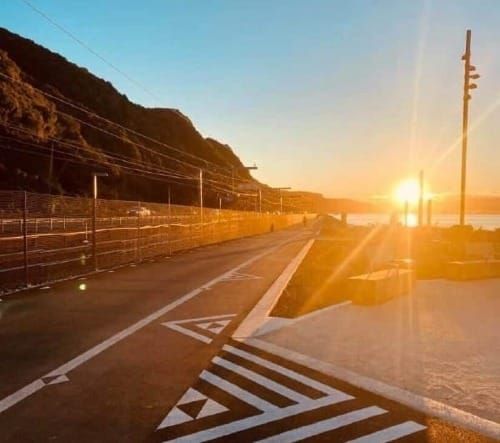
Of course, the seawall had its detractors. The mere presence of a cycle lane was enough to make some people angry and dismiss the whole thing as a vanity project. But behind the scenes, other people were quietly working. Central and local government both chipped in funding. Politicians of every stripe kept up their support, even as they were elected in and out. Officials partnered with mana whenua. Leaders worked together, the way leaders are supposed to, and when the seawall and path were opened this month, almost everyone was proud. Now cyclists push along at their own pace. Kids ride their scooters around dogwalkers. People fish off platforms. Friends walk and laugh together. Thinkers take a seat on a bench and look out to the sea. We’ve been through change, but whatever our ructions, they’ve passed.
The seawall and pathway complete a longer route that people can walk or cycle from the Hutt Valley to Wellington. This longer route is called Te Ara Tupua, a name gifted by Kura Moeahu of Taranaki Whānui. Te Ara Tupua acknowledges Ngāke and Whātaitai, the ancient ones, the creators of our harbour. They are guardians still; and not over the short spans of people, but across generations.
Notes
The statistic I’ve marked with an asterisk (*) was kindly prepared for me by a local transport data fella. I’ve put his fuller breakdown below.
The correct citation for the 2017 article by kiwi researchers is: Wild, K., Woodward, A., Field, A., & Macmillan, A. (2018). Beyond 'bikelash': engaging with community opposition to cycle lanes. Mobilities, 13(4), 505–519.
There are a bunch of reasons why figuring out cycle lane spending is hard, but one of them is that other transport projects, like improving a road, might also bundle in cycle lanes. This means cycle lanes can increase the cost of the project a bit, in a way that might be difficult to see in the books – but when you’re going to the trouble of digging up a road and disrupting people, bundling in all the changes at once only makes sense. In addition, the costs of something are usually bigger in the years it’s being built than in the years it’s being maintained. This means that picking a particular year or two doesn’t tell you much about whether something’s expensive or cheap. Looking at the whole-of-life cost of a piece of infrastructure is a better way of comparing apples with apples.
If you’d like to read more, data on people’s attitudes to active transport can be found in the 2024 Walking, Cycling and Micromobility Monitor report, by Waka Kotahi.
The statistic I mentioned above is part of this set:
|
Category |
Amount |
|
Pothole prevention (state highways and local roads) |
$5.5 billion |
|
Maintenance and operations (state highways and local
roads) |
$4.6 billion |
|
State highway improvements |
$7.0 billion |
|
Local roading improvements |
$1.3 billion |
|
Public transport infrastructure and services |
$6.4 billion |
|
Road policing and safety |
$1.7 billion |
|
North Island weather events recovery, including rail |
$1.0 billion |
|
Improving resilience and climate emergency response |
$0.39 billion |
|
Contingency for capital improvements |
$1.0 billion |
|
Footpath and cycleway improvement and maintenance |
$0.46 billion |
|
PPP and debt repayments |
$1.9 billion |
|
Rail network |
$1.0 billion |
|
Other transport investment |
$0.7 billion |
|
Total expenditure |
$32.9 billion |